The short answer
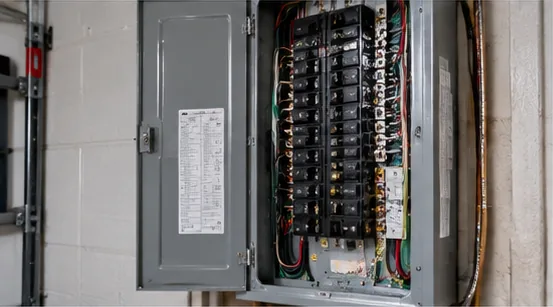
A remodel requires a panel or service upgrade when the new loads exceed what the existing service can carry, when there is no physical room for new circuits, or when the existing equipment is damaged or unsuitable. A licensed electrician answers the capacity question with a load calculation under the National Electrical Code, which Florida enforces in its 2020 edition. Many remodels fit within an existing 200-amp service; many older 100-amp services do not.
Circuits that a remodel modifies or extends generally need arc-fault protection under current code, and wet and garage locations need ground-fault protection. A service upgrade requires a permit and inspection before the utility reconnects power. HomeGuide's 2026 national data puts a 100 to 200 amp upgrade at roughly $1,400 to $2,800.
Key takeaways
- Capacity is a calculation, not a rule of thumb. Kitchen appliances, AC, EV charging and pool equipment are what move the number.
- Panel space and service capacity are different problems. A subpanel adds space, not capacity.
- The CPSC never ruled Federal Pacific breakers safe or unsafe. Independent testing and inspector reports keep the concern alive.
- Aluminum branch wiring from roughly 1965 to the mid-1970s has specific repair methods recognized by the CPSC.
- Utilities reconnect an upgraded service only after the local inspection passes, so plan for a day or more without power.
Signs Your Panel Cannot Take More Load
Some signs suggest an electrical system is near its limits or has problems that a remodel should address:
- Breakers that trip regularly when normal combinations of appliances run.
- Lights that dim when the air conditioning or a large appliance starts.
- A full panel, with no open spaces for new breakers, or many tandem breakers already.
- Warm breakers or panel covers, buzzing, or a burning smell, which call for an electrician promptly.
- A small service, such as 100 amps or less, in a house with electric range, dryer, water heater and central air conditioning.
- Old or unusual equipment, including fuse panels or brands that insurers or inspectors flag.
None of these alone proves an upgrade is needed, but each is a reason to have the system evaluated before planning major new loads. Four-point inspections for insurance also record panel type, capacity and condition, so the question sometimes comes up at purchase or renewal as well as in a remodel.
Federal Pacific and Zinsco Panels
Two older panel brands come up often in Florida inspections.
Federal Pacific Electric (FPE) Stab-Lok panels were installed in many homes built before the 1980s. Questions about whether their breakers trip reliably under overload led to a Consumer Product Safety Commission investigation, which closed in 1983 without determining whether the breakers were safe or unsafe, citing limited data and resources. Independent testing and inspector reports since then have continued to raise concerns, and many home inspectors and insurers flag these panels.
Zinsco panels, later sold under the Sylvania name, have no CPSC recall or finding against them. Inspectors and industry reports describe breakers that can fail to trip and connections to the bus bar that can overheat or arc.
Neither brand means a panel will fail. But because insurers may ask about them and because replacement is straightforward during a remodel, many owners replace them when other electrical work is planned. An electrician can assess the specific panel’s condition.
Load Calculation for a Remodel
Whether a remodel requires more capacity depends on a load calculation, not the size of the project. The National Electrical Code includes methods for existing homes that total the existing loads, add the new ones and compare the result with the service rating. In the optional method for existing dwellings, the first portion of the load is counted in full and the rest at a reduced percentage, with air conditioning counted at full value when it is added or changed.
Loads that commonly change the answer in a remodel:
- Kitchen upgrades: induction or electric ranges, double ovens, more small-appliance circuits.
- Air conditioning changes or additions, including mini-splits.
- Electric vehicle charging.
- Pool and spa equipment, including heat pumps.
- Tankless electric water heaters, which draw very large currents.
- Additions and converted spaces with their own heating and cooling.
The result can be enough capacity as is, capacity that works with load management devices or careful appliance choices, or a need for a larger service.
100A vs 200A Service
Many older Florida homes have 100-amp or smaller services, and many newer homes have 200 amps. A 100-amp service can be adequate for a smaller home with gas appliances or modest loads, but it is easily exceeded by an all-electric home with central air conditioning, an electric range and dryer, and new loads like EV charging.
A 200-amp service is common today and handles most single-family remodels, though very large homes or homes with multiple large loads, such as several air conditioning systems, pools and EV chargers, may need more. Not every remodel requires 200 amps. The calculation determines the need.
Upgrading the service involves the meter base, the service conductors, the main panel and grounding, and requires coordination with the utility. It is a larger job than replacing a panel at the same rating.
Subpanels for Additions
A subpanel is a secondary panel fed from the main panel, often installed in an addition, a converted space or a garage to provide room for new circuits close to where they are used. It solves a shortage of breaker slots and shortens circuit runs, but every amp it delivers still passes through the main service, which is why it cannot fix a service that is already too small. HomeGuide’s 2026 national data puts subpanel installation at roughly $400 to $1,500, depending on size.
EV Charger Capacity
An EV charger is often the single new load that tips a borderline service over its limit. Level 2 chargers draw substantial current for hours, and the circuit is sized for continuous use. Load management devices and chargers with adjustable current can sometimes avoid a service upgrade. The garage side of that decision, including placement and circuit details, is covered in the guide to installing an EV charger in a Florida garage.
Planning Circuits for the Remodel
The electrical plan for a remodel is more than the panel. Kitchens, bathrooms and laundry rooms have their own circuit requirements under the electrical code. A kitchen needs at least two 20-amp small-appliance circuits for countertop receptacles, bathrooms need 20-amp circuits for their receptacles, and a laundry area needs its own 20-amp circuit. Many appliances, such as dishwashers, disposals, microwaves, ranges and wall ovens, are commonly placed on individual circuits according to the manufacturers’ instructions.
Lighting plans add up as well, with recessed lights, under-cabinet lighting and exterior fixtures. Smart switches and dimmers may need a neutral conductor at the switch, which older wiring does not always have. Deciding on the circuit plan early, room by room, lets the electrician size the load calculation correctly and avoids adding circuits after walls are closed.
What Triggers a Full Rewire
A panel upgrade replaces the equipment at the center of the system. A rewire replaces the wiring that runs through the house. Remodels trigger rewiring in some circumstances:
- Deteriorated or unsafe wiring, such as brittle insulation, overheated connections or extensive amateur work.
- Obsolete wiring types, such as knob-and-tube in very old homes or ungrounded wiring where grounded circuits are needed.
- Extensive layout changes that make rerouting circuits cheaper than extending old ones.
- Aluminum branch wiring, in some cases.
In a whole-house remodel with walls open, rewiring costs less than it would later, because access is already there. HomeGuide’s 2026 national data puts whole-house rewiring at roughly $10,000 to $30,000.
Aluminum Branch Wiring
Aluminum was used for branch circuits in some homes from about 1965 to the mid-1970s. The Consumer Product Safety Commission’s guidance on aluminum wiring explains that connections in these circuits can overheat and create fire hazards, and it recognizes a limited set of permanent repairs: replacing the wiring with copper, or connecting copper pigtails with specific methods such as COPALUM crimp connectors or, where those are not available, AlumiConn connectors. Twist-on connectors and devices marked for aluminum are not considered permanent repairs. A remodel that opens walls is a good time to address it.
AFCI and GFCI Requirements Today
Florida’s building code adopts the 2020 edition of the National Electrical Code. Two protection requirements matter in remodels:
Arc-fault circuit interrupters (AFCI) protect against arcing faults that can start fires. When branch circuits in a home are modified, replaced or extended, the code generally requires them to have AFCI protection, either at the breaker or at the first outlet, with a narrow exception for short extensions that add no outlets. Older panels may not accept AFCI breakers, which can itself push toward a panel replacement.
Ground-fault circuit interrupters (GFCI) protect people against shock. The 2020 code requires GFCI protection for receptacles in bathrooms, kitchens serving countertops, garages, outdoors, laundry areas, and other damp or wet locations, including many 240-volt receptacles.
A new edition of the Florida Building Code takes effect at the end of 2026 and may adopt a newer electrical code. Work permitted after that date is reviewed under the edition in force when the permit is applied for.
Utility Coordination and Power Downtime
Replacing a panel at the same service size can often be done in a day, with power off during the work. A service upgrade takes more coordination. The electrician pulls a permit, the utility is scheduled to disconnect the service, new equipment is installed, the building department inspects, and the utility reconnects.
Utilities in the area require the inspection before reconnecting. OUC, for example, states that electrical services must be inspected by the city or county before power is connected, and Duke Energy states that it cannot connect a service, including an upgraded one, without the required permit and inspection. Depending on scheduling, a household may be without power for most of a day or longer. Planning the upgrade for a mild-weather day, and early in a remodel before other trades need power, avoids complications.
Cost Range
HomeGuide’s 2026 cost data gives these national ranges:
- Panel replacement at the same rating: roughly $850 to $1,700.
- Upgrade from 100 to 200 amps: roughly $1,400 to $2,800.
- Upgrade to 400 amps: roughly $2,000 to $4,000.
- Subpanel: roughly $400 to $1,500.
- Whole-house rewire: roughly $10,000 to $30,000.
These national ranges are for planning only and are not a quote from SAVAM House or anyone else; the licensed electrician’s price depends on the panel’s location, the utility’s requirements, permit fees and what the inspection turns up.
Local prices depend on the utility’s requirements, the distance from meter to panel, whether the meter base and service conductors need replacing, permit fees, and wall or stucco repair around the equipment. These are costs for licensed electrical work. Under Florida law, electrical contracting requires a certified or registered electrical contractor, with a narrow exemption for owners doing work on their own home.
In a remodel, the electrical plan is set early so that the panel, new circuits and any service change are done before walls close. Electrical upgrades belong in the overall remodeling budget as their own line, since they are easy to underestimate when the focus is on finishes.
The service upgrade has its own permit and inspection, and which trades need their own permits is one of the first things to settle when the scope is written.
In a whole-house remodel, electrical work is coordinated with the rest of the project and performed by a licensed electrical contractor under its own permit.
Share this article