The short answer
In Central Florida, your permit comes from the city building department if the house is inside city limits, and from the county if it is in an unincorporated area. Structural, electrical, plumbing, mechanical and gas work need permits. Since July 1, 2026, Florida law requires local governments to exempt other work under $7,500 on a single-family home from a building permit, if the owner or contractor submits a written request and the property is not in a flood hazard area.
Permitted work is inspected in stages before it is covered, and the permit is closed after the final inspection. HOA architectural approval is a separate process. Unpermitted or unclosed work tends to surface when the house is sold or insured, and Florida law provides ways to close old permits.
Key takeaways
- Check whether the address is incorporated. Orlando, Winter Park, Kissimmee and Clermont each run their own building departments.
- The $7,500 exemption excludes electrical, plumbing, structural, mechanical and gas work, and properties in flood hazard areas.
- Owner-builder permits require the owner to sign in person, supervise the work and not sell or lease the home within a year.
- Jobs over $5,000 generally need a recorded Notice of Commencement before the first inspection.
- An HOA may not require a building permit before it reviews your application, and a permit does not replace HOA approval.
Start With Who Issues Your Permit
Florida has one statewide building code, currently the Florida Building Code, 8th Edition (2023), with a 9th Edition expected to take effect at the end of 2026. Who administers it for a given house depends on where that house sits.
Incorporated cities and towns generally run their own building departments or contract the work out. Unincorporated areas are served by the county. Two homes a short drive apart can therefore deal with different offices, different online portals, different fee schedules and different local amendments, even though the underlying code is the same.
A few Central Florida examples show how this plays out:
- Homes inside Orlando city limits, including Lake Nona, go through the City of Orlando’s permitting division, while nearby Dr. Phillips and Horizon West, which are unincorporated, go through Orange County.
- Winter Park, Winter Garden and Ocoee each run their own building departments. The Town of Windermere uses a contracted building department rather than Orange County’s.
- Celebration is unincorporated and goes through Osceola County, while Kissimmee has its own building division.
- Four Corners has no city government of its own and spreads across the corners of four counties, so the building department is whichever county the parcel falls in.
The property appraiser’s record for the parcel, or the building department itself, will confirm which office has jurisdiction. That is the first question to settle, before drawings or schedules.
What Needs a Permit
Florida law requires a permit to construct, alter, modify, repair or demolish a building, with exemptions set by the code, by statute and by local rules. In practice, remodeling work that needs a permit includes:
- Structural work: removing or altering walls that carry load, new openings, beams, framing changes and additions.
- Electrical work: new circuits, panel changes and service upgrades.
- Plumbing work: moving fixtures, new supply or drain lines and repipes.
- Mechanical work: air conditioning equipment and ductwork changes.
- Gas work of any kind.
- Building envelope work: windows, exterior doors and roofing, which in Florida involve wind-load requirements and are routinely permitted. How small envelope jobs are treated under the new exemption described below is worth confirming locally.
Since July 1, 2026, Florida law also requires local governments to exempt an owner of a single-family home, or the owner’s contractor, from a building permit for work valued at less than $7,500. The exemption does not apply to electrical, plumbing, structural, mechanical or gas work, or to property partly or entirely in a flood hazard area. The owner or contractor must submit a written request with the contract or other proof of the work’s nature and value. Work like painting, cabinet replacement in the same footprint or new flooring often falls within it when the value is under the threshold.
Because local rules and this new exemption are still being put into practice, a quick call or online check with the building department for your address is the reliable way to confirm what a specific project needs.
Owner-Builder Affidavits
Florida allows owners to act as their own contractor under an exemption in the contractor licensing law. The owner must personally appear and sign the permit application, receive and sign a disclosure statement, and directly supervise any work not done by licensed contractors. The work must be for the owner’s own use and not for sale or lease, and selling or leasing the home within a year of completion creates a presumption that the work was done for sale.
Owner-builder permits shift responsibility for code compliance, safety and hiring onto the owner. They can make sense for experienced owners on limited projects. For structural, electrical or plumbing work, many owners prefer a licensed contractor to hold the permit.
Flood Hazard Areas
Central Florida is not coastal, but many neighborhoods border lakes, rivers, wetlands and drainage areas mapped as flood hazard areas. Two rules make that important for a remodel. The new state exemption for small jobs does not apply to property partly or entirely in a flood hazard area. And under the floodplain rules that local governments enforce for the National Flood Insurance Program, improvements to a building in a flood zone whose cost reaches half of the building’s market value are treated as substantial improvements, which can require bringing the whole building up to current flood-resistant standards. The local floodplain administrator, often part of the building or engineering department, can say whether a property is affected and how the value of the work is measured.
Private Providers
Florida law lets a property owner, or the contractor with the owner’s written permission, hire a licensed private provider to perform plan review, inspections or both instead of the building department, with written notice to the building official. Local fees are reduced for the services the private provider performs. Private providers are used more often on larger projects, where faster review or inspection scheduling offsets their cost, and the building department still issues the permit and the certificate of completion.
What to Have Ready Before Applying
A complete application moves faster than a partial one. Depending on the scope, building departments typically ask for:
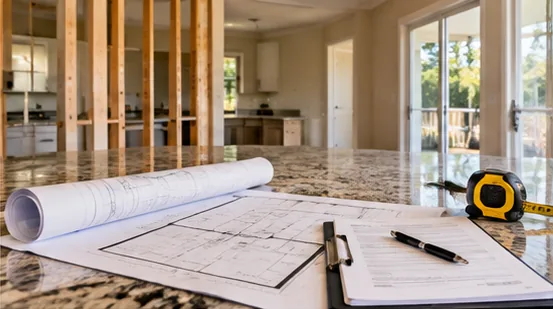
- Drawings showing existing and proposed work, and for structural changes, sealed engineering.
- Product approvals for windows, doors, shutters and roofing, with design pressures.
- Trade information for electrical, plumbing and mechanical work, often on separate permits pulled by each licensed contractor.
- Energy code documentation where air conditioning, windows or insulation change.
- Contractor license and insurance information, or the owner-builder disclosure.
- A recorded Notice of Commencement before the first inspection on jobs over $5,000.
Associations run their own process at the same time, so having the HOA submission ready alongside the permit application saves weeks.
Orange County
Orange County’s Division of Building Safety handles permits for unincorporated areas, including Dr. Phillips and Horizon West, through its online Fast Track system for applications and inspections. Inside the county, the City of Orlando, Winter Park, Winter Garden, Ocoee and other municipalities run their own permitting. Homes in Orlando city limits, for example, apply through the city rather than the county, even though they are in Orange County.
Seminole County
Seminole County’s Building Division, based in Sanford, serves unincorporated Seminole County with online permitting and electronic plan review. Cities in the county, such as Sanford, Lake Mary, Oviedo, Winter Springs, Altamonte Springs, Casselberry and Longwood, have their own building departments or arrangements, so an address inside one of them goes through the city.
Osceola County
Osceola County’s Building Office serves unincorporated areas, including Celebration and much of the Four Corners area on the Osceola side, through an online permit center. Kissimmee and St. Cloud issue their own permits. Because Osceola includes large areas of vacation homes, owners there should also ask whether any work affects the home’s use as a short-term rental, which carries its own local requirements.
Lake County
Lake County Building Services, in Tavares, handles unincorporated Lake County through an online permitting portal. Cities including Clermont, Minneola, Groveland and Mount Dora run their own building departments, sometimes with contracted inspection services. The fast growth around Clermont and Minneola means review times and inspection availability can change with demand.
Polk County
Polk County’s Building Division, in Bartow, handles unincorporated Polk, including parts of the Four Corners and Davenport-area communities outside city limits, through an online portal. The City of Davenport, Haines City, Lakeland and other municipalities issue their own permits. For homes near the county line, confirming the parcel’s jurisdiction is especially important.
The Inspection Sequence Explained
Inspections happen at defined points, before each stage of work is covered. For a typical remodel, the sequence includes some or all of these:
- Structural or framing inspection after walls, beams or openings are framed.
- Rough-in inspections for electrical, plumbing and mechanical work before walls and ceilings are closed.
- Insulation inspection where required.
- Drywall or other intermediate inspections in some jurisdictions.
- Final inspections for each trade and for the building permit, after the work is complete.
The rough-in inspections are the most important, because the work they check is hidden once walls are closed. Covering work before it passes means opening it up again. Where these inspections fall among demolition, rough-in, drywall and finishes is easier to picture in the full sequence of a home remodel.
Notice of Commencement
A Notice of Commencement is a document recorded with the county clerk that identifies the property, the owner, the contractor and the lender, and starts the framework of Florida’s construction lien law. When the direct contract is over $5,000, a copy must be filed with the building department before the first inspection, with an exception for repair or replacement of existing air conditioning systems under $15,000. Without it, inspections cannot proceed. A copy is also posted on the job site.
The notice protects owners from paying twice when subcontractors or suppliers are not paid, but only if payments are handled according to the lien law. Owners with larger projects often ask a real estate attorney or their lender for guidance on lien releases.
Re-Inspection Fees
Failed inspections are common and are resolved with corrections and a re-inspection. Local governments set their own fees, and Florida law requires a fee of four times the original inspection or first re-inspection fee once the same violation has failed the first inspection and one re-inspection. The practical lesson is to have work reviewed before calling for inspection, rather than using the inspector to find problems.
HOA Architectural Review Is Separate
Many Central Florida neighborhoods are governed by homeowners associations with architectural review committees. Their approval is required for many exterior changes, such as windows, doors, roofing, screen enclosures and paint colors, and sometimes for interior work that affects the exterior or involves contractors on site.
HOA approval and building permits are separate processes, run by different bodies, and one does not replace the other. As of 2026, Florida law prohibits associations from requiring a building permit as a prerequisite for their review, so owners can submit to the HOA first and apply for permits in parallel. Submitting early to both avoids delays.
Unpermitted Work and Resale Risk
Unpermitted work may come to light in a home inspection, an insurance inspection or an appraisal. Buyers may ask for it to be permitted, for a price reduction, or may walk away. Insurers may question unpermitted electrical or plumbing work. Appraisers may not count unpermitted living space in finished area. In Florida, sellers have a legal duty, established in the 1985 Supreme Court case Johnson v. Davis, to disclose known facts that materially affect a home’s value and are not readily observable, which can include unpermitted work.
Legalizing unpermitted work after the fact is possible in many cases, but it can mean opening walls for inspection, bringing work up to current code and paying additional fees. Doing it right the first time is almost always cheaper. The same logic applies with extra force to projects like garage conversions, where zoning and parking rules come into play as well as the building code.
Closing Out Open Permits
A permit is not finished when the work is done. It is finished when the final inspection passes and the building department closes it. Open or expired permits often surface during a sale, when a title search or permit search shows them.
Florida law gives owners several tools. An owner can close an open or expired permit by hiring the original contractor or a new licensed contractor, or by acting as an owner-builder, and substantially completed work under an expired permit can be closed under the code in effect when the permit was applied for. The building department may close a permit six years after issuance without a final inspection if it finds no apparent safety hazard. Buyers who purchase a home in an arm’s-length sale cannot be denied permits or fined solely because a previous owner left a permit open.
Permits for single-family homes also have time limits: under Florida law, they expire one year after issuance or on the effective date of the next edition of the building code, whichever is later, unless extended. Projects that pause between stages need to plan around that, which is one of the costs weighed when splitting a remodel into phases.
Checking for open permits before buying a home, and before starting new work, avoids surprises. Planning which permits a project needs, and in what order, is part of scoping a remodel that touches the whole house, where structural, trade and inspection sequencing are coordinated across it. This article is general information about Florida’s permitting framework, not legal advice for a specific property.
Share this article