The short answer
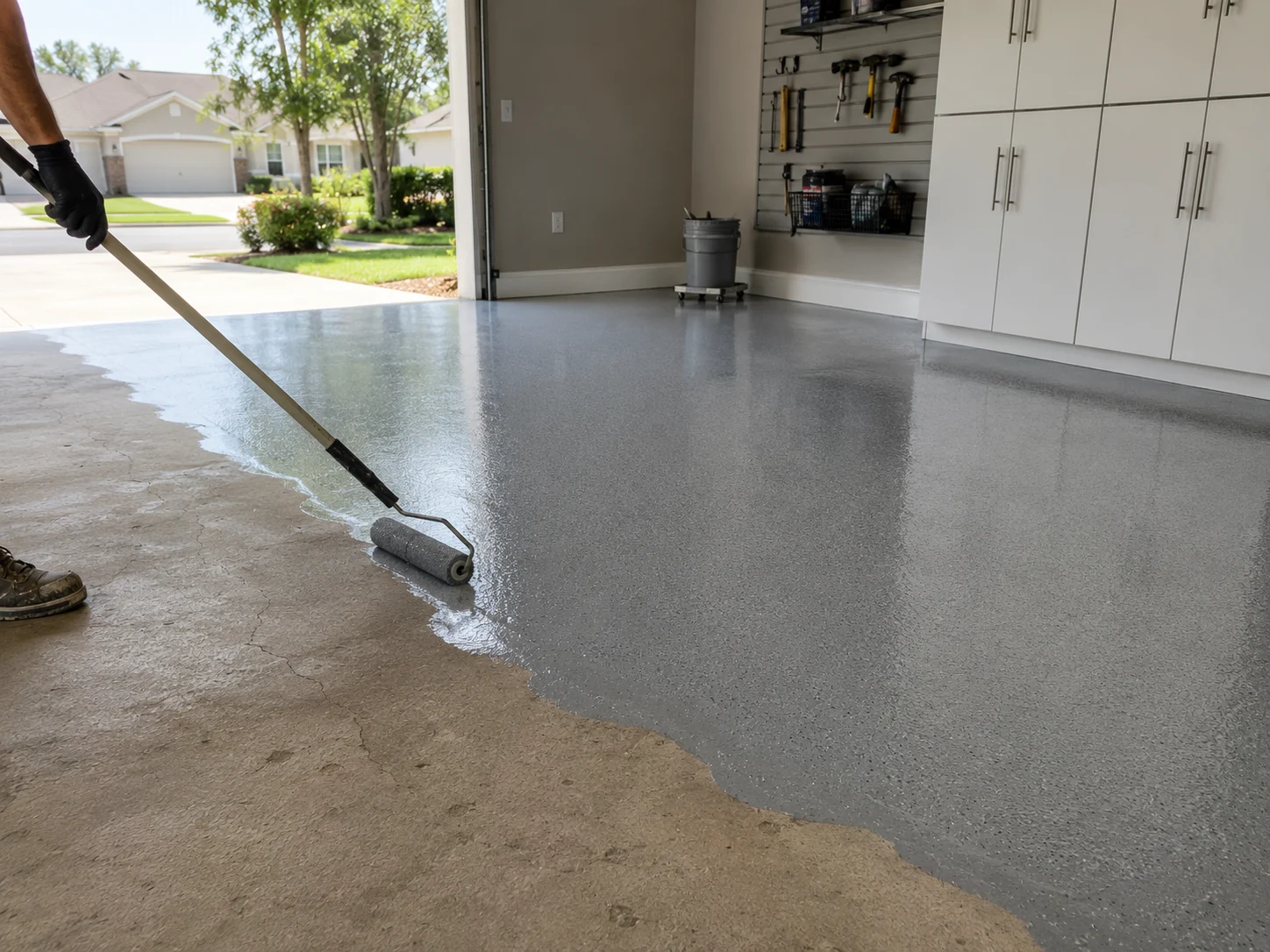
A professionally installed epoxy garage floor starts with diamond grinding to open the concrete, a moisture check, crack and joint repair, then a base coat, optional decorative flake or metallic layer, and a clear topcoat. Done well on a sound, dry slab, it resists oil, water and tire traffic for many years.
HomeGuide's 2026 national figures put epoxy garage floors at about $4 to $10 per square foot, or roughly $1,600 to $5,800 for a typical two-car garage. Preparation and the topcoat chosen move the price more than the color does. Install usually takes a couple of days, with a longer wait before cars park on it.
Key takeaways
- Surface preparation decides whether a coating lasts. Grinding gives a profile that acid etching often cannot reach.
- A slab with too much moisture vapor pushes coatings off from below. Testing before coating is cheaper than redoing it.
- Standard epoxy yellows in sunlight, so the strip by the garage door usually needs a UV-stable topcoat.
- Hot tire pickup is a bonding problem more than a product problem. Prep and film thickness prevent most of it.
- Retail kits apply a thin film over poorly prepared concrete, which is why they so often peel within a few seasons.
Why Concrete Alone Does Not Last in a Florida Garage
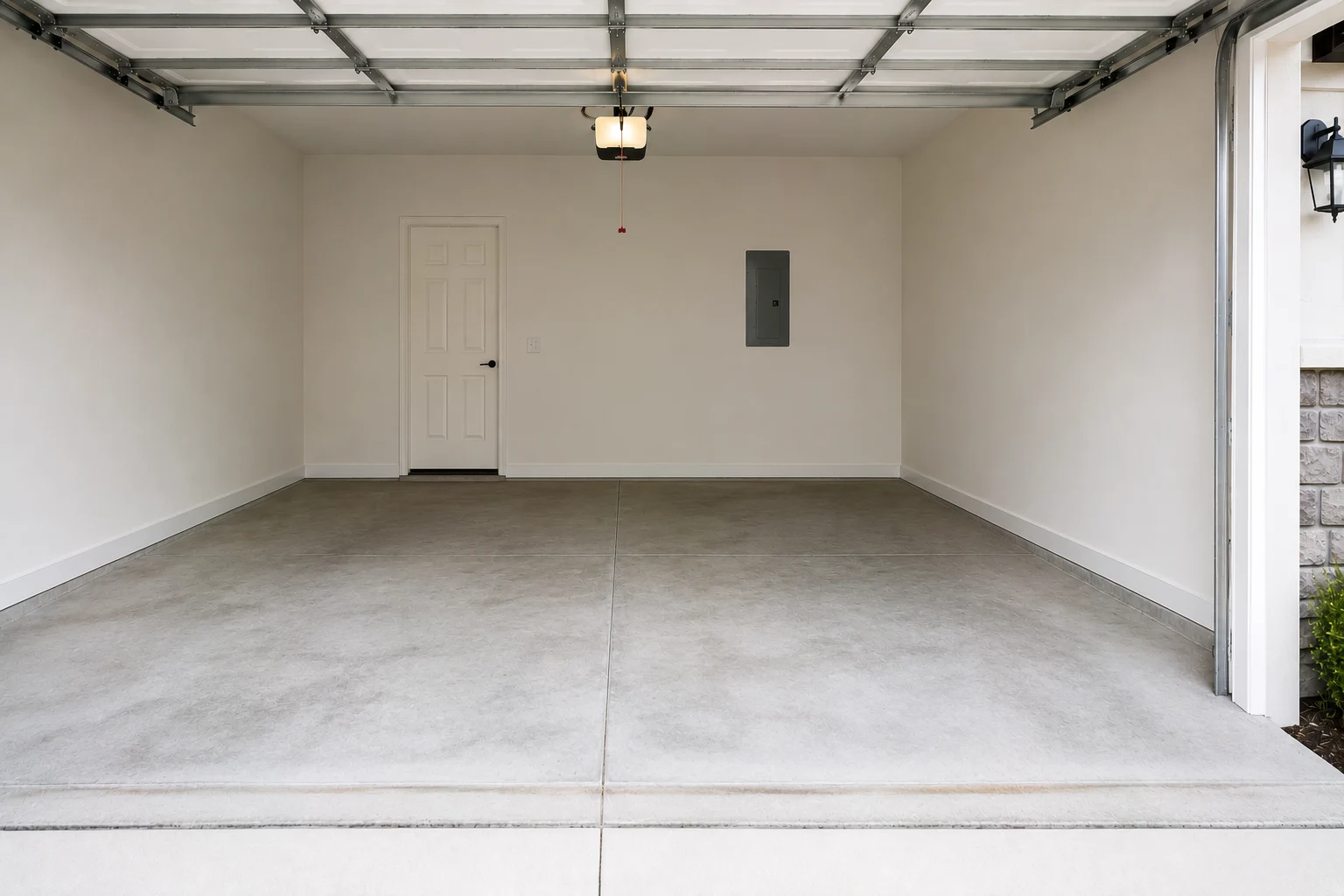
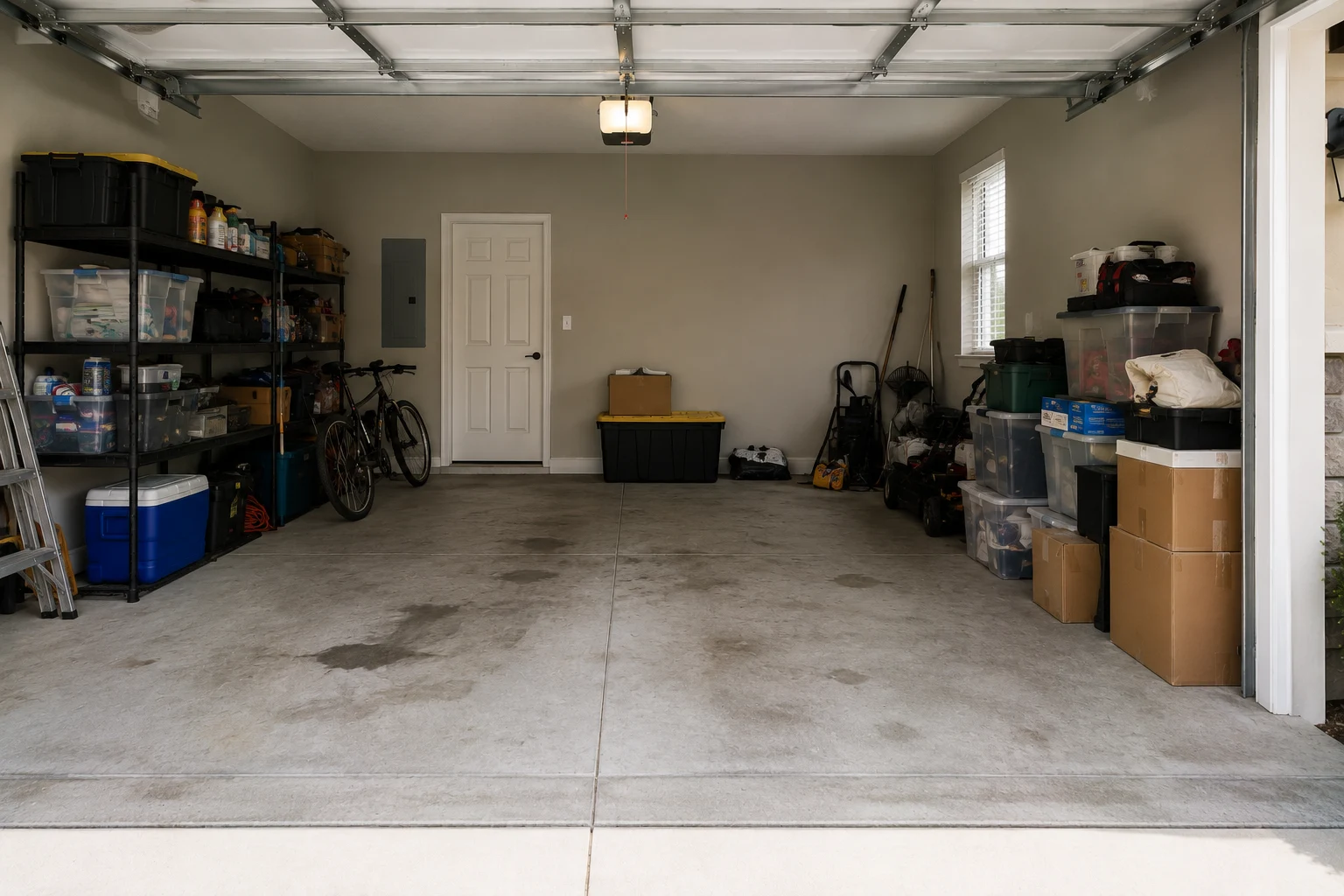
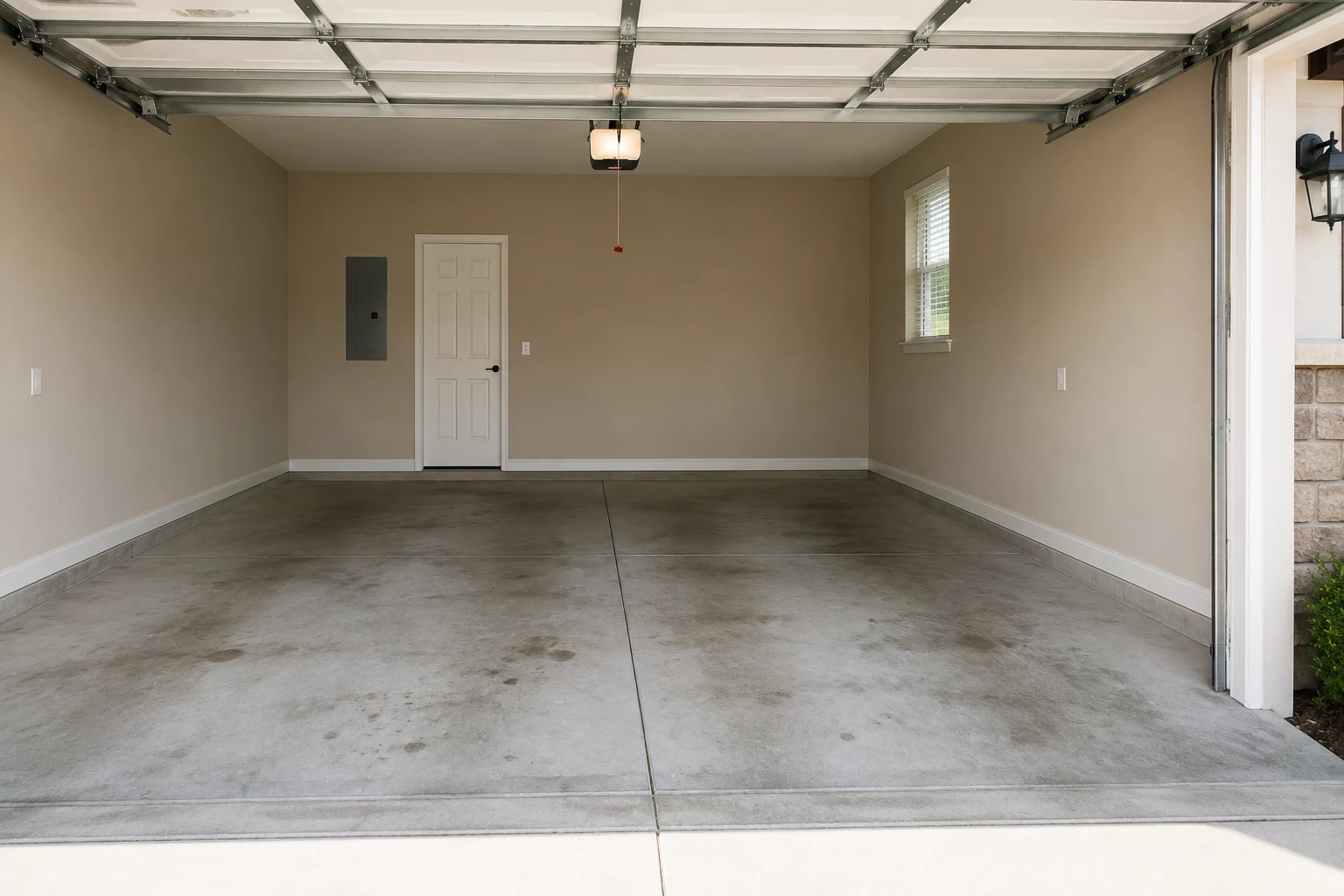
Bare concrete looks tough, but it is porous. Oil, transmission fluid, fertilizer, pool chemicals and the dirty water that drips off cars in summer storms soak into it and leave stains that pressure washing only partly removes. The surface also dusts over time, and that fine powder gets tracked into the house.
Central Florida adds its own pressures. Garages here stay hot and humid for much of the year, wet tires come in almost daily in the rainy season, and many slabs rest on sandy ground where the water table rises in the wet season. None of that destroys a slab quickly, but it makes an unprotected floor look worn years before the concrete itself has a structural problem.
A coating seals the surface so spills sit on top and wipe off, stops the dusting, and makes the room brighter. The catch is that a coating only protects concrete it is properly bonded to. When a garage floor coating fails, it is almost always because that bond was never established, not because the product was bad.
Epoxy vs Polyaspartic vs Polyurea
“Epoxy floor” has become the generic name for any garage floor coating, but three different chemistries are sold under it.
Epoxy is a two-part resin that cures into a hard, thick film with strong adhesion to concrete. It is forgiving to install, builds thickness well and is usually the most affordable of the three. Its weakness is sunlight: standard aromatic epoxy yellows and chalks when exposed to UV.
Polyaspartic is an aliphatic polyurea variant. It cures much faster, stays clear in sunlight and resists abrasion well, but it has a short working time and costs more.
Polyurea in the strict sense cures extremely fast and is flexible. In residential garages it is most often used as a basecoat in systems designed by the manufacturer, and the name is sometimes used loosely for polyaspartic products.
Most professional garage systems combine them: an epoxy or polyurea base for adhesion and build, and a polyaspartic or polyurethane topcoat for UV and wear. The trade-offs between the two main topcoat choices, including cure speed and cost, are laid out in the comparison of polyaspartic and epoxy coatings.
| Epoxy | Polyaspartic | Polyurea (basecoat) | |
|---|---|---|---|
| Cure speed | Slow | Fast | Very fast |
| Working time for the installer | Generous | Short | Very short |
| UV stability | Yellows in sun | Stable | Depends on product |
| Typical role | Base and body coats | Topcoat or full system | Basecoat in some systems |
Why Surface Prep Decides Everything
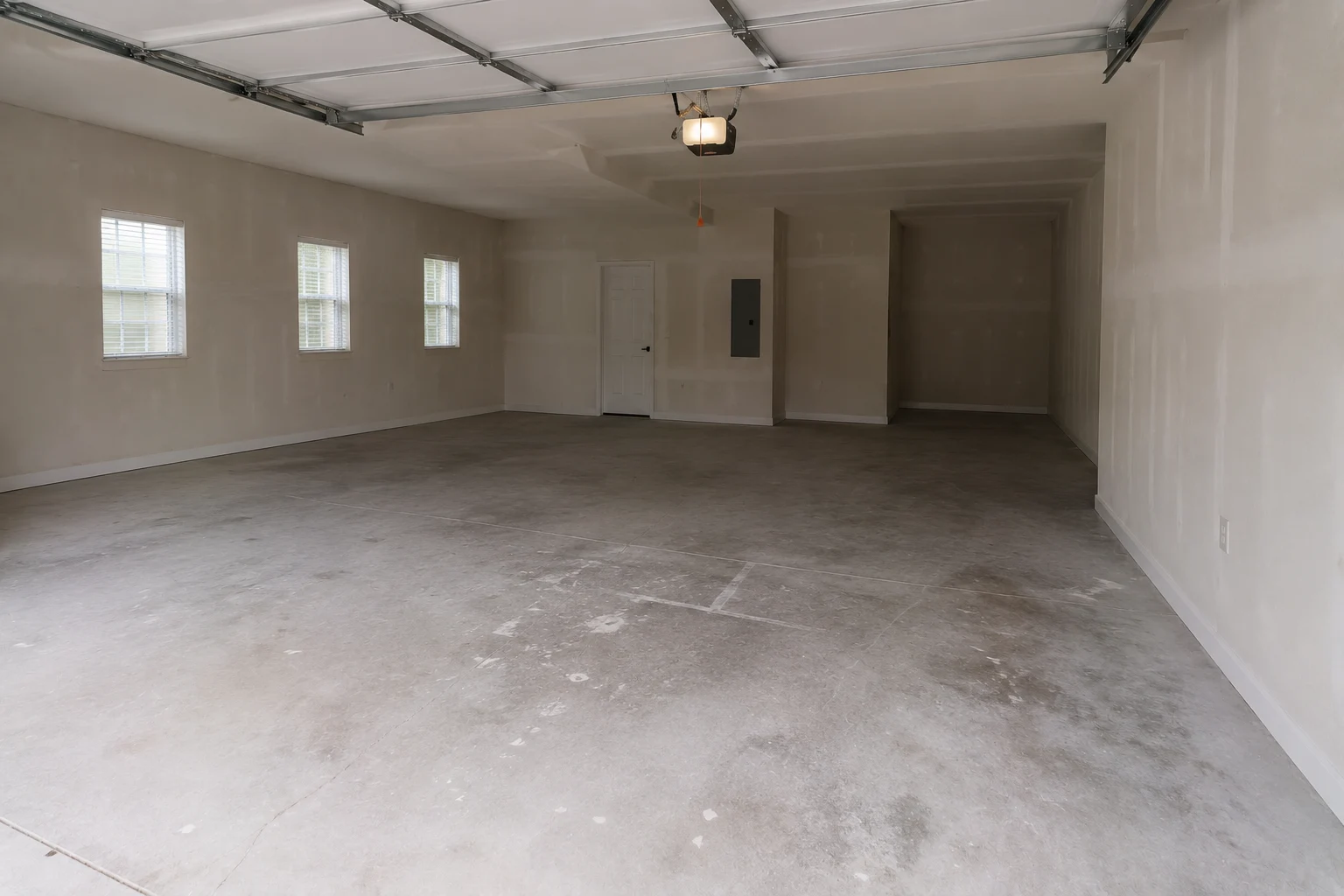
Concrete straight from the finisher’s trowel has a dense, smooth top layer, and a garage floor that is a few years old also carries oil, tire residue, curing compounds or old sealers. None of these give a coating anything to hold onto.
Preparation does three things. It removes contaminants and weak surface material, opens the pores of the concrete so the resin can penetrate, and creates a texture, called a concrete surface profile, that the coating grips mechanically. The International Concrete Repair Institute grades that texture on a scale from CSP 1, nearly flat, to CSP 10, very rough. Thin sealers need little profile; thicker coating systems need more, and the coating manufacturer specifies the range.
Preparation also includes the less visible work: degreasing oil spots that grinding alone will not lift, filling cracks and pitting, treating control joints, and removing any previous coating. On older slabs, this part can take as long as the coating itself, and it is the part a low quote usually leaves out.
Diamond Grinding vs Acid Etching
There are two common ways to profile a garage floor.
Acid etching uses a diluted acid solution that reacts with the surface, followed by thorough rinsing and drying. It is cheap and needs no equipment, which is why retail kits rely on it. ICRI guidance limits acid etching to the lightest profiles, roughly CSP 1 to 3. It does not remove oil or sealers, it adds water to a slab that then has to dry out completely, and residue left behind interferes with bonding.
Diamond grinding uses a floor grinder with diamond tooling, connected to a dust extractor, to cut away the top layer of the concrete. It removes contaminants and weak surface paste, leaves a consistent profile that suits thicker coating systems, and leaves the slab dry. It needs professional equipment and experience, but it is the method most coating manufacturers specify for garage systems today.
Moisture Testing the Slab First
Concrete slabs on grade are not sealed from the ground. Moisture moves up through them as vapor, and a coating on top acts like a lid. If enough vapor reaches the underside of the coating, it builds pressure and can push the coating off the concrete, sometimes in blisters, sometimes in sheets. Slabs without an effective vapor retarder below them, and garages on low sites, are the ones most at risk. Floors inside the house face the same vapor, and testing a slab before new flooring uses the same standard methods.
Two standard tests measure it. ASTM F1869, the calcium chloride test, measures the moisture vapor emission rate from the surface over a few days; a commonly cited limit for many coatings is 3 pounds per 1,000 square feet per 24 hours. ASTM F2170 measures relative humidity with probes placed inside drilled holes in the slab; many manufacturers set a limit around 75 percent. Those numbers are common reference points, not universal rules. The coating manufacturer’s limit is the one that applies.
A simpler first check is taping a clear plastic sheet to the floor for a day or two and looking for darkening or condensation underneath. It can show a problem but cannot rule one out, so it is not a substitute for a real test when moisture is suspected. When readings are high, moisture-mitigating primers designed for that condition exist, and they add cost that is worth knowing about before the job starts.
Delamination and Bubbling
Delamination is a coating lifting away from the concrete, and bubbling is air or vapor trapped under or inside the film. Both usually trace back to preparation or moisture: a contaminated or poorly profiled surface, a slab that was still damp, outgassing from porous concrete on a warming day, or a coat applied too thickly at once. Small bubbles that appear during application are often from outgassing; blisters that appear weeks later suggest moisture from below.
Flake, Metallic and Solid Color Systems
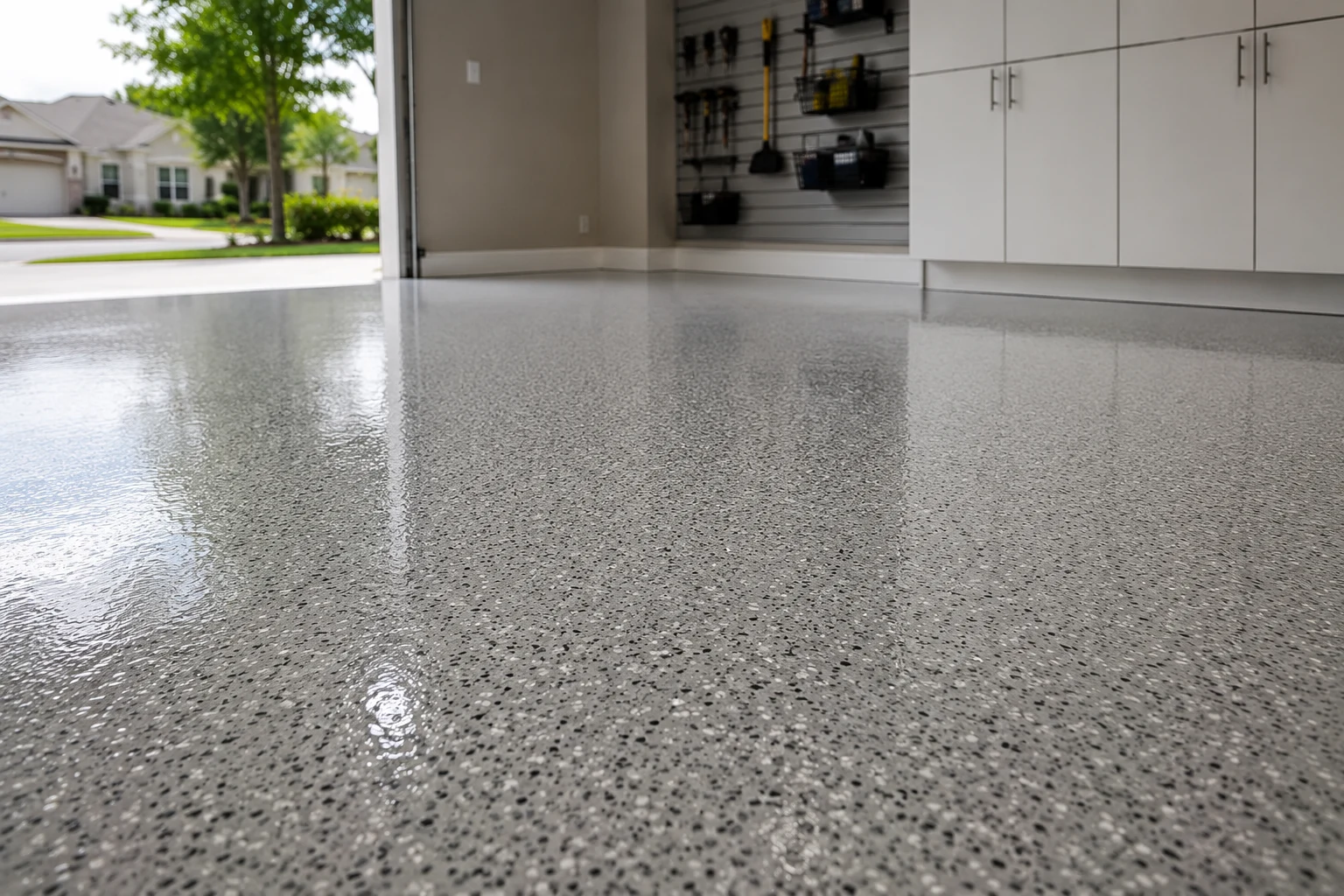
Flake systems are the most common garage finish. After the base coat, colored vinyl chips are broadcast across the wet resin, often to full coverage, then scraped and sealed with a clear topcoat. The flake hides imperfections in the slab, adds texture, and makes dirt and small scratches far less visible.
Metallic systems use pigments that move within the resin to create a marbled, reflective look. They are striking in a showroom garage or a converted space, but they are more technique-sensitive, show scratches and dust more easily, and are usually smoother and more slippery.
Solid color systems are a pigmented base with a clear or tinted topcoat. They look clean and industrial, cost less than decorative finishes, and show dirt, tire marks and every flaw in the slab.
Hot Tire Pickup
Car tires get hot on Florida roads. When a hot tire sits on a coating and then cools, it can grip the surface, and when the car pulls away it can lift the coating with it, leaving bare patches in the tire paths. This is called hot tire pickup.
It mostly happens with thin coatings over poorly prepared concrete, and with low-cost paints marketed as garage floor coatings. A properly bonded system with adequate thickness and a hard topcoat resists it. Letting the coating reach full cure before parking also matters, since a soft film is more vulnerable in its first days.
UV Yellowing at the Door Line
Standard epoxy exposed to sunlight turns yellow and loses gloss over time. In a garage, that shows up as a band along the door opening where afternoon sun reaches the floor, most visibly on light colors and clear coats. It does not usually weaken the coating, but it looks uneven. A UV-stable topcoat such as polyaspartic or aliphatic polyurethane over the epoxy prevents it, which is one of the main reasons hybrid systems are popular in Florida.
How Long Installation Takes
For a typical two-car garage with an epoxy system, installation usually runs about two days, and sometimes more when the floor needs significant repair. A common sequence looks like this:
- Clearing the garage and grinding the floor, with dust extraction.
- Repairing cracks, pitting and joints, then grinding the repairs flush.
- Applying the base coat and, if chosen, broadcasting the flake.
- Scraping loose flake and applying the topcoat once the base has cured enough.
Then there is curing. Foot traffic is typically fine within about a day, but vehicles usually wait several days, and full chemical resistance can take up to about a week. Heat speeds curing; humidity and cool nights slow it. The product’s data sheet sets the times, and they should be written into the plan so the garage stays empty long enough. Faster-curing polyaspartic systems can compress this schedule, which is one of their main selling points.
Cost per Square Foot
HomeGuide’s 2026 cost data puts professionally installed epoxy garage floors at about $4 to $10 per square foot, or roughly $1,600 to $5,800 for an average two-car garage. Polyaspartic systems in the same data run somewhat higher. Those are national figures, and a Central Florida price can land on either side of them depending on the slab’s condition, the moisture test results and the coating system specified.
What moves a quote within that range:
- Condition of the slab. Crack repair, pitting, old coating removal and oil treatment add time and material.
- Moisture mitigation. A vapor-mitigating primer, when tests call for one, is a significant added cost.
- System and thickness. Number of coats, full or partial flake broadcast, and topcoat chemistry.
- Finish. Metallic systems usually cost more than flake or solid color.
- Size and layout. Small garages cost more per square foot because setup and mobilization are fixed costs.
When comparing quotes, compare the full scope: preparation method, repair allowance, number and type of coats, topcoat chemistry, and cure time before parking. A quote that seems low often omits grinding or uses a thinner system, and the difference shows up a few years later. Coating is one piece of a broader garage remodeling plan that may include storage, lighting and outlets, and sequencing matters: the floor usually goes in before cabinets are installed on top of it.
How Long an Epoxy Floor Lasts
There is no single lifespan for an epoxy floor, because the number depends almost entirely on how it was built and how it is used. A thick, multi-coat system over a ground, dry, repaired slab behaves very differently from a single thin coat rolled over etched concrete, even though both are sold as “epoxy floors.”
The factors that shorten a floor’s life are predictable: moisture pushing up from the slab, sunlight on an epoxy topcoat, heavy point loads such as jack stands and motorcycle kickstands, dragging steel equipment, and harsh cleaners. The factors that extend it are the reverse: good preparation, adequate film thickness, a UV-stable wear layer and reasonable care.
Wear usually shows first in the topcoat, as dulling and fine scratches in the tire paths and at the entry door. On a well-bonded system, the topcoat can often be cleaned, lightly abraded and recoated to renew the surface without starting over. That is a much smaller job than removing a failed coating, which is another reason the base layers deserve the most attention. The written warranty, and what it excludes, is a more reliable guide to what a specific installer expects than any general figure.
Why DIY Kits Peel
Retail epoxy kits are popular because they are inexpensive and the photos look good. Many of them fail within a few years, usually for predictable reasons:
- Acid etching instead of grinding. The kit’s etching step rarely produces the profile a durable coating needs and does not remove oil or sealers.
- Thin film. Many kits are water-based epoxy or epoxy-fortified paint applied with a roller. The film is a fraction of the thickness of a professional system.
- No moisture testing. A damp slab pushes the coating off from below.
- No UV topcoat. Sunlight at the door line yellows and weakens it.
- Parking too soon. Hot tires lift a coating that has not fully cured.
A kit can be a reasonable choice for a light-use garage where the owner accepts a shorter life and does careful preparation. It is not equivalent to a ground, tested, multi-coat system, and removing a failed kit before a professional coating adds cost later.
What to Ask Before Hiring
A good epoxy installer can answer these clearly:
- How will the floor be prepared, and what profile does the coating need?
- Will the slab be tested for moisture, and what happens if it fails?
- What is the complete system, coat by coat, and what is the topcoat?
- How are cracks, joints and old coatings handled, and is that in the price?
- When can I walk on it, and when can I park on it?
- What does the warranty cover, and what excludes it, such as moisture from below?
The answers matter more than the color samples. Two floors that look identical on the day they are finished can behave very differently a few Florida summers later, and the difference is almost always in the steps before the first coat.
Share this article