The short answer
Almost every Central Florida house sits on a concrete slab poured directly on the ground, and that concrete can release water vapor for as long as the house stands. Vinyl, wood, laminate and their adhesives each have moisture limits set by the manufacturer, and a slab that exceeds them can cause adhesive failure, cupping, odor or mold under the floor. The only reliable way to know is to test before installation.
The two standard tests are in-situ relative humidity probes (ASTM F2170) and the calcium chloride test (ASTM F1869). The results are compared with the limits in the chosen product's installation instructions. When readings are too high, options include a moisture mitigation system, a different product or, for some floating floors, a polyethylene vapor retarder the manufacturer accepts.
Key takeaways
- A slab on grade is in contact with the soil, and moisture moves up through the concrete as vapor even when the surface looks dry.
- Florida's residential code requires a vapor retarder under new slabs, but it can be torn during construction, and older or modified slabs may not have an effective one.
- RH probe testing measures moisture inside the slab; the calcium chloride test measures what leaves the surface over a few days.
- There is no universal safe number. Each flooring and adhesive manufacturer publishes its own limits and test method.
- Test results describe the slab at the time and places tested; conditions such as irrigation, drainage and new additions can change them.
Why Slab Moisture Causes So Many Floor Failures
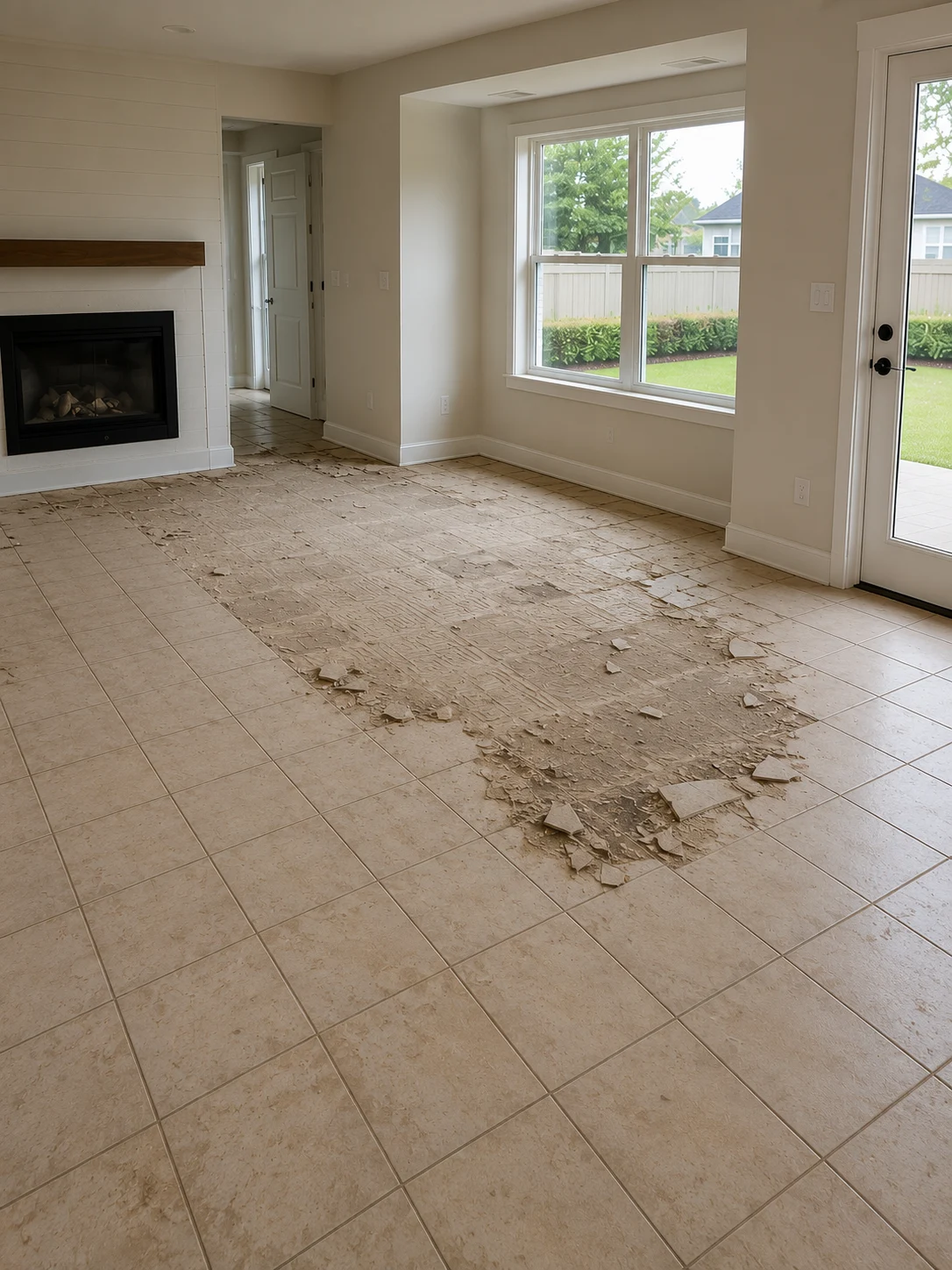
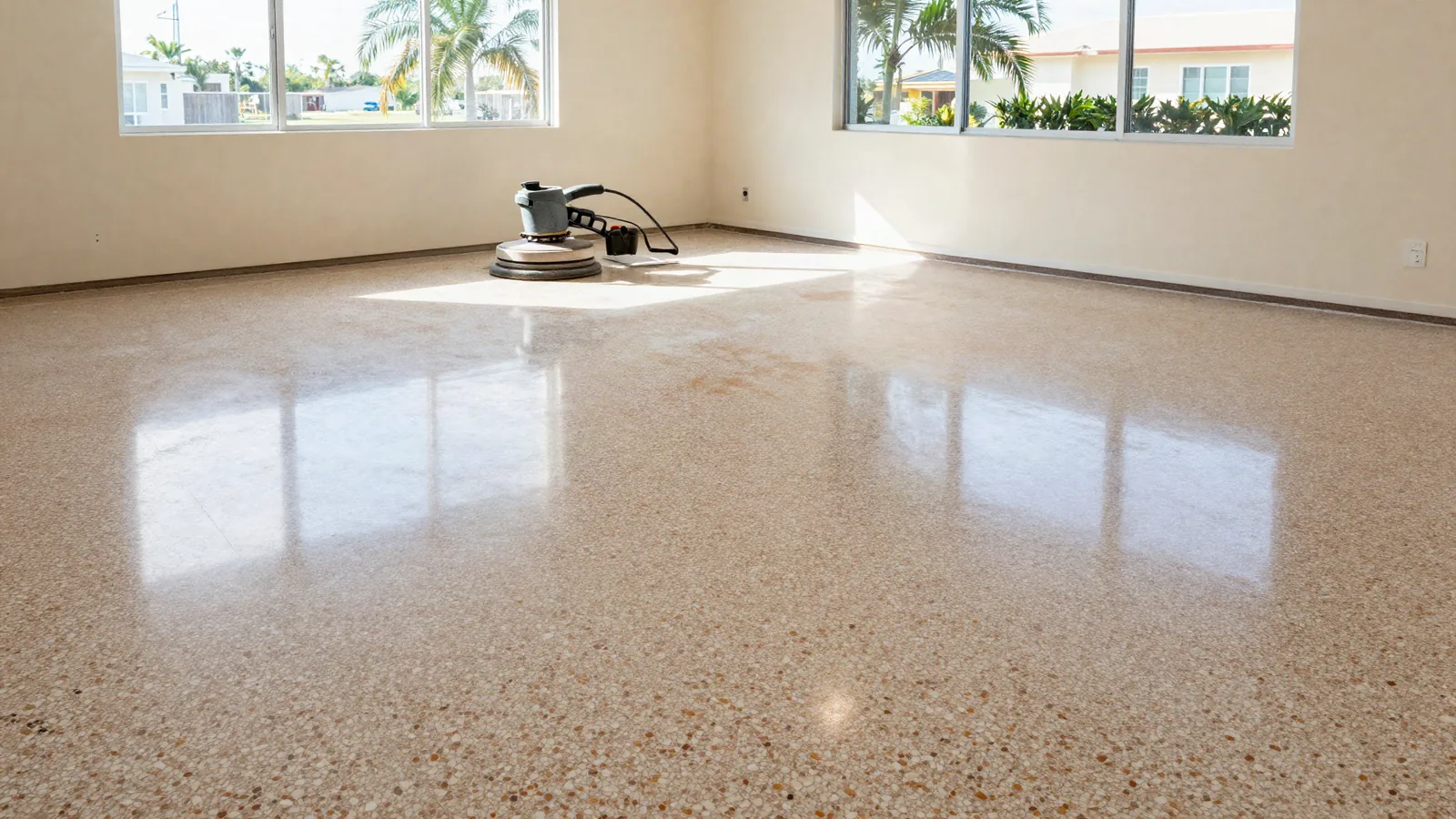
Houses in Central Florida are overwhelmingly built slab on grade: the floor is a concrete slab poured on compacted soil, with no crawlspace or basement between the ground and the living space. Every floor in the house, from bedroom carpet to kitchen tile, sits on that concrete.
Concrete is porous. Water in the soil below, and water left over from mixing the concrete, moves up through the slab as vapor. Bare concrete lets that vapor escape into the room. A floor covering changes that. Vinyl, some underlayments and many adhesives slow or stop the vapor, so moisture collects right where the adhesive is, or under a floating floor where air cannot reach.
Not every floor failure starts with moisture. Poor flatness, missing expansion gaps and heavy sun cause their share. But moisture is one of the most common hidden causes, it is invisible on installation day, and it is cheap to check compared with replacing a floor. That is why flooring manufacturers ask for a moisture test before installation over concrete, and why a failure on an untested slab can leave the owner without warranty support.
How Moisture Moves Through Concrete
Moisture in a slab behaves in two ways. Water left from mixing slowly dries out through the top surface, which can take months in a new slab. Ground moisture moves up from below, continuously, when there is no effective barrier under the concrete.
Florida’s residential code addresses the second source. It requires a vapor retarder, a 6-mil polyethylene sheet or approved equivalent with joints lapped at least 6 inches, between the slab and the base below it in new construction, with limited exceptions for spaces such as garages and unheated accessory structures. That sheet reduces moisture from the ground but does not eliminate it, and it only works if it stayed intact while the slab was poured.
Air conditioning matters too. Cool, dry indoor air pulls moisture out of the slab surface. A house that sat closed without air conditioning, or a room where the system was off during renovation, tests differently than it will once people live there. Testing standards call for the space to be at its normal living conditions for a period before testing, so the result reflects how the floor will actually live.
Homes Built Before Vapor Retarders
Older homes, early additions and converted spaces may have been built without an effective retarder under the slab, or with one that was punctured by stakes, rebar supports and foot traffic during the pour. There is no way to tell from the surface. Neither age nor appearance says whether a slab is dry enough, which is another reason to test every project rather than assume.
Post-Tension Slabs
Post-tensioned slabs, reinforced with steel tendons held under high tension, are common in Central Florida residential construction. The relative humidity test involves drilling small holes into the slab. Those holes are shallow, but anyone drilling into a post-tensioned slab should know where the tendons run, and the same applies to grinding or cutting during preparation. Following the builder’s slab markings or scanning the slab first is the safe approach.
Garages Converted to Living Space
Garage slabs deserve special attention. Florida’s residential code exempts garages from the under-slab vapor retarder requirement, so a garage converted into a bedroom, office or family room may have no retarder at all. Garage slabs also slope toward the door and may sit lower than the house floor, so conversion projects often combine moisture testing, mitigation and leveling before any flooring goes down.
Irrigation and Grade Issues
Moisture problems are often worse at the edges of the house. Sprinkler heads that spray the foundation, soil or mulch graded toward the wall, missing gutters and downspouts that empty against the slab all add water where the floor meets the exterior walls. Test results near those walls may be higher than in the middle of a room. Correcting drainage and irrigation outside is often part of solving a moisture problem inside.
Calcium Chloride vs RH Probe Testing
Two ASTM methods are used for flooring over concrete, and manufacturers specify which one their limits refer to.
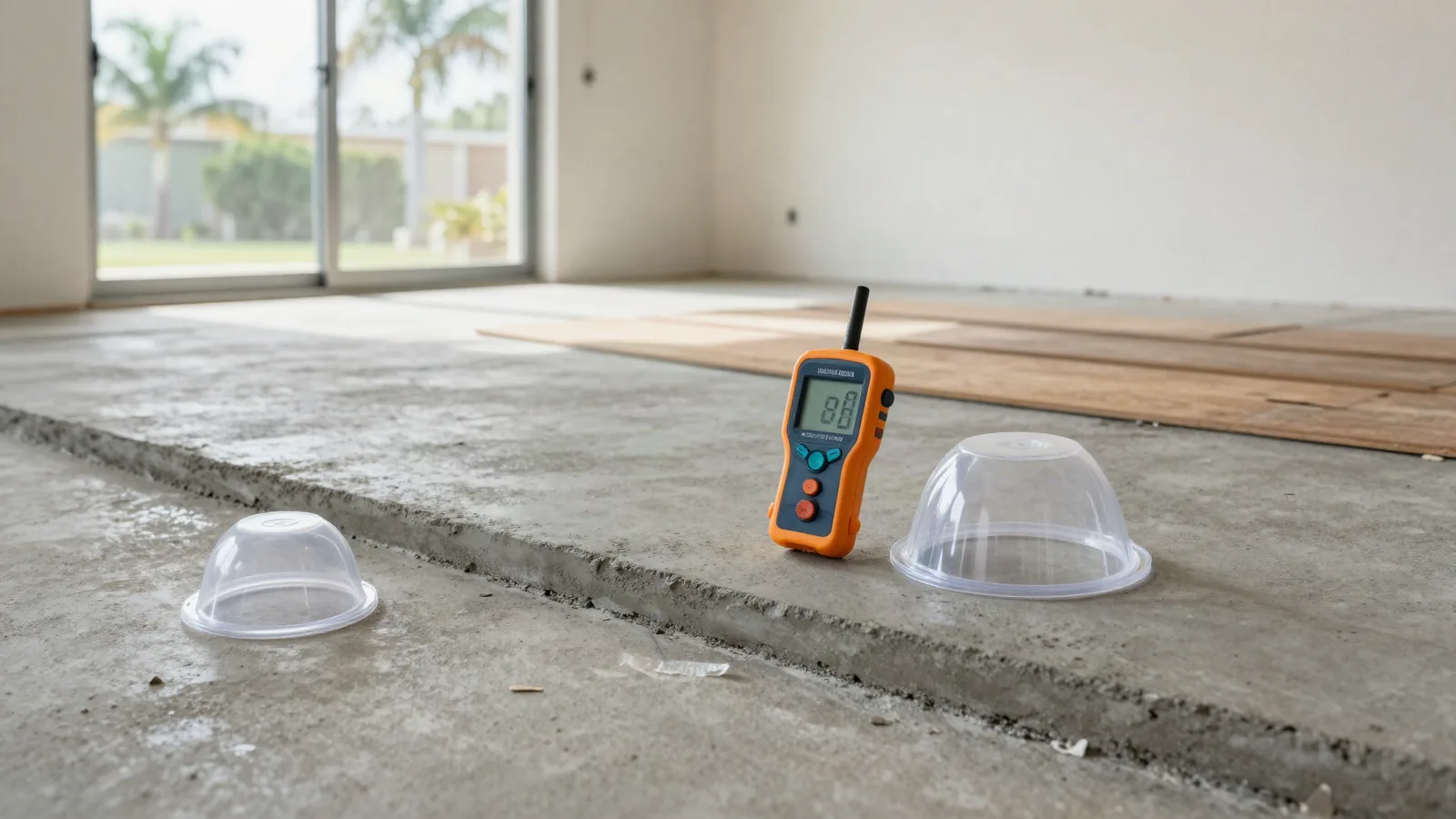
Relative humidity probes, ASTM F2170. Holes are drilled into the slab to a set depth, 40 percent of the slab thickness for a slab that dries only from the top, which is the usual case for slabs on grade. Sensors are placed in the holes and allowed to equilibrate, 24 hours under the current version of the standard, before readings are taken. The result is the relative humidity inside the concrete, which predicts what the slab will do once it is covered. The standard calls for three tests in the first 1,000 square feet and one more for each additional 1,000 square feet.
Calcium chloride, ASTM F1869. A dish of calcium chloride is sealed under a plastic dome on a cleaned area of concrete for roughly three days, then weighed. The weight gained gives the moisture vapor emission rate, expressed as pounds of water released from 1,000 square feet of slab in a day. It measures moisture leaving the top of the slab during the test, and it is sensitive to surface condition and room conditions.
Both results apply only to the locations tested and the day they were taken. A slab can test differently after heavy rain, after a change in irrigation or after the air conditioning has run for a few weeks.
Acceptable Readings by Flooring Type
There is no universal safe reading. Each manufacturer sets limits for its product, adhesive and installation method, and those limits vary widely. As an example, Mohawk’s installation instructions for its SolidTech rigid-core vinyl floating floor call for a moisture emission rate of 8 pounds or less or relative humidity below 90 percent, and pH between 5 and 9, while its UltimateFlex glue-down vinyl allows up to 99 percent relative humidity with the same emission limit. Other brands, and other products from the same brand, set different numbers.
| Floating rigid-core vinyl | Glue-down vinyl | Engineered wood | Porcelain tile | |
|---|---|---|---|---|
| Main concern | Moisture and mold under the floor | Adhesive breakdown | Cupping and adhesive failure | Setting materials and membranes |
| Where limits come from | Flooring manufacturer | Flooring and adhesive manufacturers | Wood and adhesive manufacturers | Mortar and membrane manufacturers |
| Typical approach when readings are high | Vapor retarder if accepted, or mitigation | Mitigation or a more tolerant adhesive | Mitigation or another product | Follow setting system limits |
Wood is the most sensitive of the common choices, since it absorbs moisture and changes shape. Adhesives are often the weak point for glue-down floors, because moisture and alkalinity can break them down. Tile set in cement-based mortar tolerates more moisture than most finishes, but crack isolation membranes, waterproofing and some adhesives still have limits. The product chosen and its installation method decide which numbers apply, so the test is planned after the floor is chosen, not before.
Moisture Mitigation Coatings
When a slab tests above the product’s limits, the usual remedy for glue-down floors, wood and many resilient products is a moisture mitigation system: a coating applied to the concrete that sharply reduces the vapor passing through it. These are typically epoxy-based or similar products applied over mechanically prepared concrete, followed by a primer and a cement-based underlayment when the system calls for it.
Performance is specific to each product. ARDEX, for example, rates its MC Rapid moisture control system for concrete with relative humidity up to 100 percent and lists its permeance at 0.06 perms. Other systems have different ratings. The mitigation product, the underlayment and the flooring adhesive should be approved to work together, ideally from the same system, so each manufacturer supports the assembly.
Mitigation adds material, labor and cure time before the floor can go down. It also depends on surface preparation: coatings applied over dust, old adhesive or a smooth troweled surface can fail. The preparation involved overlaps with flattening and preparing a slab, and the two steps are usually planned together.
Vapor Barriers Under Floating Floors
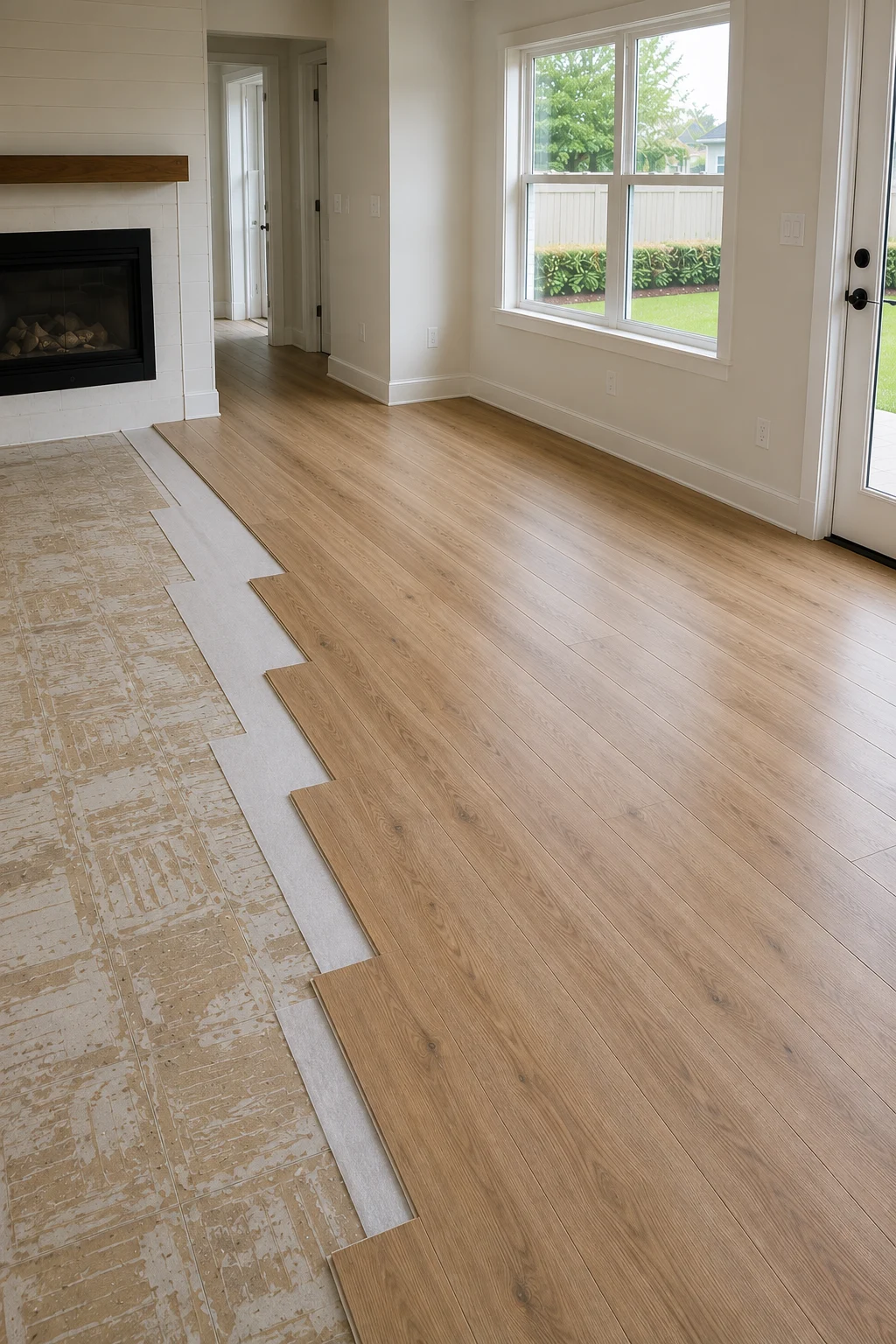
Floating floors, such as rigid-core vinyl and laminate, are not glued to the slab, so there is no adhesive to break down. They can still trap moisture between the slab and the floor, where it can cause odor, mold or damage to the underlayment and the planks’ locking joints.
Many manufacturers recommend or require a polyethylene sheet under floating floors on concrete. Mohawk’s SolidTech instructions, for instance, highly recommend 6-mil polyethylene for floating installations, lapped at the seams. Some underlayments include an attached vapor barrier. Whether a sheet is enough depends on the test results and the manufacturer’s limits: a vapor retarder handles normal slab moisture, not a slab with water problems.
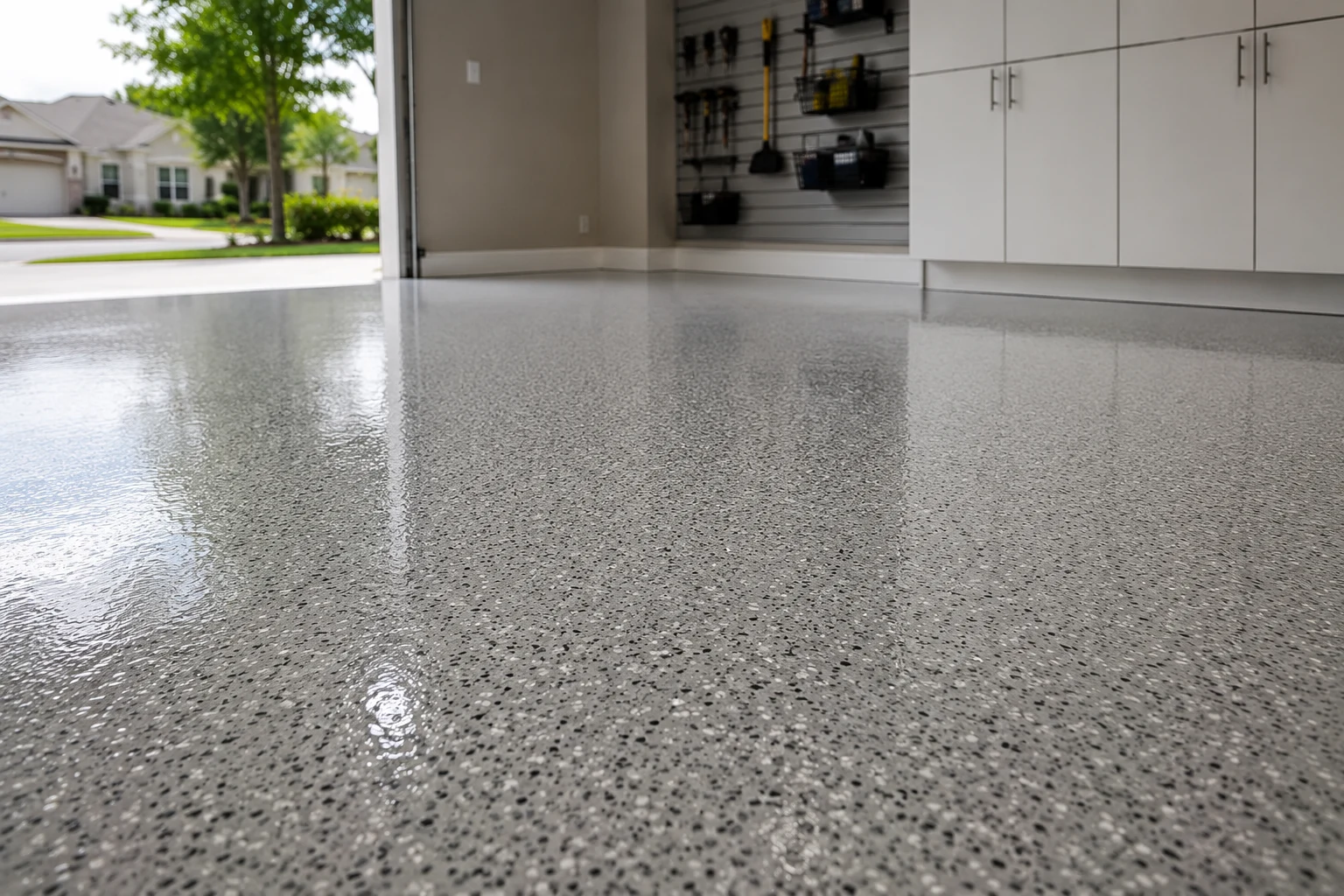
Garage floors face the same physics with a different finish. A coating bonded to a garage slab can be pushed off by vapor from below, which is why moisture testing comes before an epoxy garage floor as well.
What Happens When You Skip the Test
Moisture problems usually appear months after installation, not on day one:
- Adhesive failure: glue-down planks or tiles that lift, shift or show adhesive oozing at the seams.
- Cupping and gaps in wood: boards that curl at the edges or gap as moisture changes.
- Odor and mold: a musty smell from under a floating floor, sometimes with mold on the underside of the planks or underlayment.
- White residue: salts carried up by moisture that appear at seams or on concrete when the floor is removed.
- Warranty problems: manufacturers generally ask for documented moisture results, and a claim without them is harder to support.
Every one of these is more expensive to fix than to prevent. Fixing them usually means removing the floor, letting the slab dry, treating it and installing new material.
Reading a Moisture Report
A useful moisture report is more than a single number. It should state the ASTM method used, the date, the number of tests and where each was placed on a simple floor plan. For relative humidity probes, it should record the slab thickness assumed, the depth of the holes and the equilibration time. For calcium chloride tests, it should list the test duration and how the surface was prepared. Both types should note the room temperature and humidity and whether the air conditioning was running.
The readings are then compared with the limits for the specific flooring and adhesive. A reading that passes for one product may fail for another, so the report and the product data sheet are read together. Keeping both with the house records helps if a problem appears later or when the next floor is chosen.
Cost of Testing vs Cost of Failure
A moisture test costs a small fraction of a flooring project, even with several test points across a large open area. Mitigation, when needed, is a larger line item, but it is known before installation and can be priced into the decision, including choosing a product with a higher moisture tolerance.
The alternative is finding out after the floor is installed. At that point the cost includes removing and disposing of the failed floor, moving furniture again, living with the disruption, treating the slab and buying a new floor. Adding testing to every flooring quote over concrete is a small cost against that risk, and the written result protects the owner as well as the installer.
Planning the Test Into the Project
Planning the test into the project from the start, alongside product choice, keeps the schedule predictable. Slab moisture is one reason a quality floor sometimes fails early, and it sits beside wear layer, sun and subfloor flatness among the factors explained in the factors behind vinyl plank lifespan.
For a whole house of new floors, moisture testing belongs in the first site visit of the flooring installation process, before a product is ordered.
Share this article