The short answer
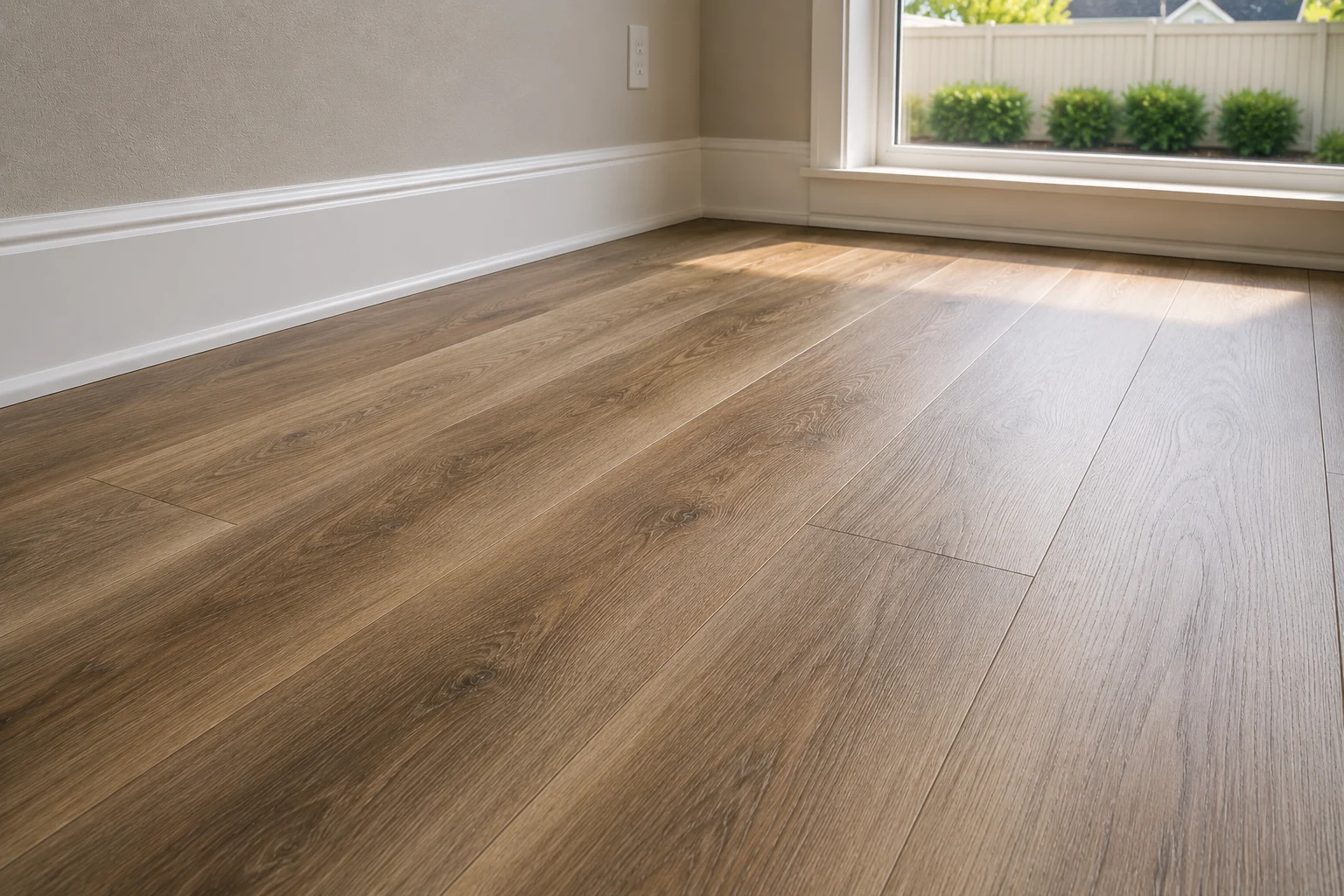
The three floors differ in one structural way that decides everything else: hardwood has a wearable layer of real timber that can be sanded and refinished, luxury vinyl plank has a printed layer that cannot be refinished but can be replaced plank by plank, and laminate has a printed layer over a fibreboard core that is neither refinishable nor tolerant of water reaching it.
For most Central Florida homes the practical field narrows quickly. Houses here are built on concrete slabs, and solid hardwood is not the natural choice over a slab. That leaves engineered hardwood for households that want real timber, and rigid-core vinyl plank for households that want the fewest constraints.
Laminate remains a legitimate choice in genuinely dry rooms where budget is the binding constraint, and a poor one anywhere water is a realistic event. Modern vinyl plank has taken most of the territory laminate used to occupy, at a similar price for the mid-range products.
Key takeaways
- Hardwood is refinished, vinyl plank is replaced in pieces, and laminate is replaced in full. That single difference is what the three-way choice is really about.
- Laminate has a fibreboard core. Once water reaches it the swelling is permanent, which is the clearest line between laminate and vinyl plank.
- Solid hardwood is not the natural choice over a concrete slab. Engineered hardwood exists precisely to solve that problem and is why it dominates in Florida.
- Not every engineered hardwood can be refinished. The number of times depends on the thickness of the real wood veneer, and thin veneers should be treated as unrefinishable.
- Vinyl plank and laminate look similar in a showroom and behave differently in a wet laundry. Compare the core, not the photograph.
- Keep spare boxes of whichever you choose. Repairability only helps if the batch can still be matched years later.
Luxury Vinyl Plank (LVP) vs. Laminate Flooring
These two are compared more often than any other pair in flooring, and for a good reason: in a showroom they can be almost indistinguishable. Both are planks with a printed decorative layer under a transparent wear layer. The difference is underneath.
What each one actually is
Laminate is a printed decorative paper over a high-density fibreboard core, sealed with a hard wear layer. The core is a wood product, which means it is stiff, hard underfoot, and permanently damaged once water reaches it.
Rigid-core vinyl plank is a printed film over a solid polymer core, either stone-composite or wood-plastic composite. The core does not absorb water at all, which is the entire reason the category displaced laminate in most of the market.
That single structural difference produces almost every practical distinction between them.
| Rigid-core vinyl plank | Laminate | |
|---|---|---|
| Core material | Solid polymer, does not absorb water | High-density fibreboard, absorbs water |
| Response to standing water | Unaffected; can be lifted and dried | Swells permanently at the edges |
| Underfoot | Warmer, quieter, slight give | Harder and louder; underlayment matters |
| Surface hardness | Softer; can dent under point loads | Harder; more resistant to scratching |
| Repair of a damaged plank | Individual plank replaceable | Replaceable, but matching is harder |
| Subfloor tolerance | Most forgiving of minor variation | Needs a flatter substrate |
| Best suited to | Kitchens, laundries, entries, whole houses | Dry bedrooms and living rooms on a budget |
Reading it by scenario: vinyl plank wins anywhere water is a realistic event, which in a Florida house includes the kitchen, the laundry, the entry from the pool deck and any room adjoining them. Laminate wins on two counts only — surface hardness, where it genuinely resists scratching better, and price at the entry level. If the room is dry and stays dry, laminate is a reasonable choice. If there is any doubt, the fibreboard core settles it.
The trade-off within vinyl plank itself is a separate question, decided by the wear layer rather than by the category, which we cover in our guide to how long luxury vinyl plank lasts.
Engineered Hardwood vs. Solid Hardwood
This pair is frequently misunderstood as a quality comparison, with engineered assumed to be the compromise version. It is not. It is a construction difference, and in Florida the engineered version is usually the technically correct one.
The difference is the build, not the species
Solid hardwood is a single piece of timber through its whole thickness. Because wood moves with moisture, a solid board expands and contracts across its width with the seasons, and that movement is what dictates how and where it can be installed.
Engineered hardwood is a real wood veneer bonded to a cross-layered plywood or composite core. The layers run in alternating directions, which largely cancels out that seasonal movement. The surface is the same timber, the same species and the same finish. What changes is dimensional stability.
| Engineered hardwood | Solid hardwood | |
|---|---|---|
| Construction | Real wood veneer over cross-layered core | One piece of timber throughout |
| Movement with humidity | Minimal; layers counteract each other | Expands and contracts across the width |
| Over a concrete slab | Designed for it; glue or float | Needs additional construction to be viable |
| Refinishing | Depends on veneer thickness; once or twice | Multiple times over decades |
| Plank width available | Wide planks are stable | Wide planks move more and gap more |
| Main risk to manage | Buying a veneer too thin to ever refinish | Moisture and the substrate beneath it |
Reading it by scenario: engineered hardwood wins in almost every Central Florida house, because almost every Central Florida house is built on a slab and lives in high humidity. Solid hardwood wins where there is a suitable wood subfloor, where the owner intends to keep the floor for decades and refinish it repeatedly, and where the climate inside the house is stable year-round.
The specification that decides whether you actually own a wood floor
The veneer thickness is the number to ask for, and it is rarely on the display. A thick veneer can be sanded and refinished, which means the floor can be restored in twenty years. A thin veneer cannot be sanded without cutting through to the core, which means the floor will be replaced rather than restored — and at that point you have bought the maintenance profile of a vinyl plank at the price of a wood floor.
Hardwood vs. Luxury Vinyl Plank
This is the decision most Central Florida households actually face, once laminate has been ruled out on water and solid hardwood on the slab. It is usually framed as real versus imitation, which is the least useful way to think about it.
The honest framing is year twelve
Both floors will look good for the first several years if they are installed properly. What separates them is what happens when they stop looking good.
A wood floor is restored. Sanding removes the damage of a decade and returns a surface that is genuinely new, at a cost and a disruption that is real but is far less than replacement.
A vinyl plank floor is not restored, because the printed layer cannot be renewed. Damage to an individual plank is repaired by replacing that plank, which is quick and cheap — provided you kept spare material from the original batch. When the floor as a whole is worn, it is replaced.
Neither of those is better. They are different ownership models, and the right one depends on how long you intend to keep the house and how much disruption you are willing to accept later.
| Engineered hardwood | Rigid-core vinyl plank | |
|---|---|---|
| Surface | Real timber, unique grain | Printed film; repeats across the room |
| End-of-life path | Refinish and keep | Replace planks, then eventually the floor |
| Water tolerance | Resists; not indifferent | Core unaffected by water |
| Scratch behaviour | Marks the finish; repairable | Marks the wear layer; permanent |
| Underfoot | Warm, solid, quiet | Warm, quiet, slight give |
| Relative cost position | Higher material and labour | Lower on both |
| Best suited to | Long tenure, dry rooms, restorable floor wanted | Active households, wet rooms, whole-house continuity |
Reading it by scenario: engineered hardwood wins where the household plans to stay for a long time, the rooms are dry, and there is real value placed on a surface that can be brought back rather than thrown away. Vinyl plank wins in a busy household with children, animals and a route in from the pool deck, and it wins on whole-house continuity because it can run through kitchens and laundries where wood should not go.
There is a third position worth naming, because it is what many houses in the area end up with: engineered hardwood in the bedrooms and living areas, and vinyl plank or tile in the kitchen, laundry and entries. It is a compromise, it creates transitions at the doorways, and it is frequently the right answer.
Where porcelain tile fits
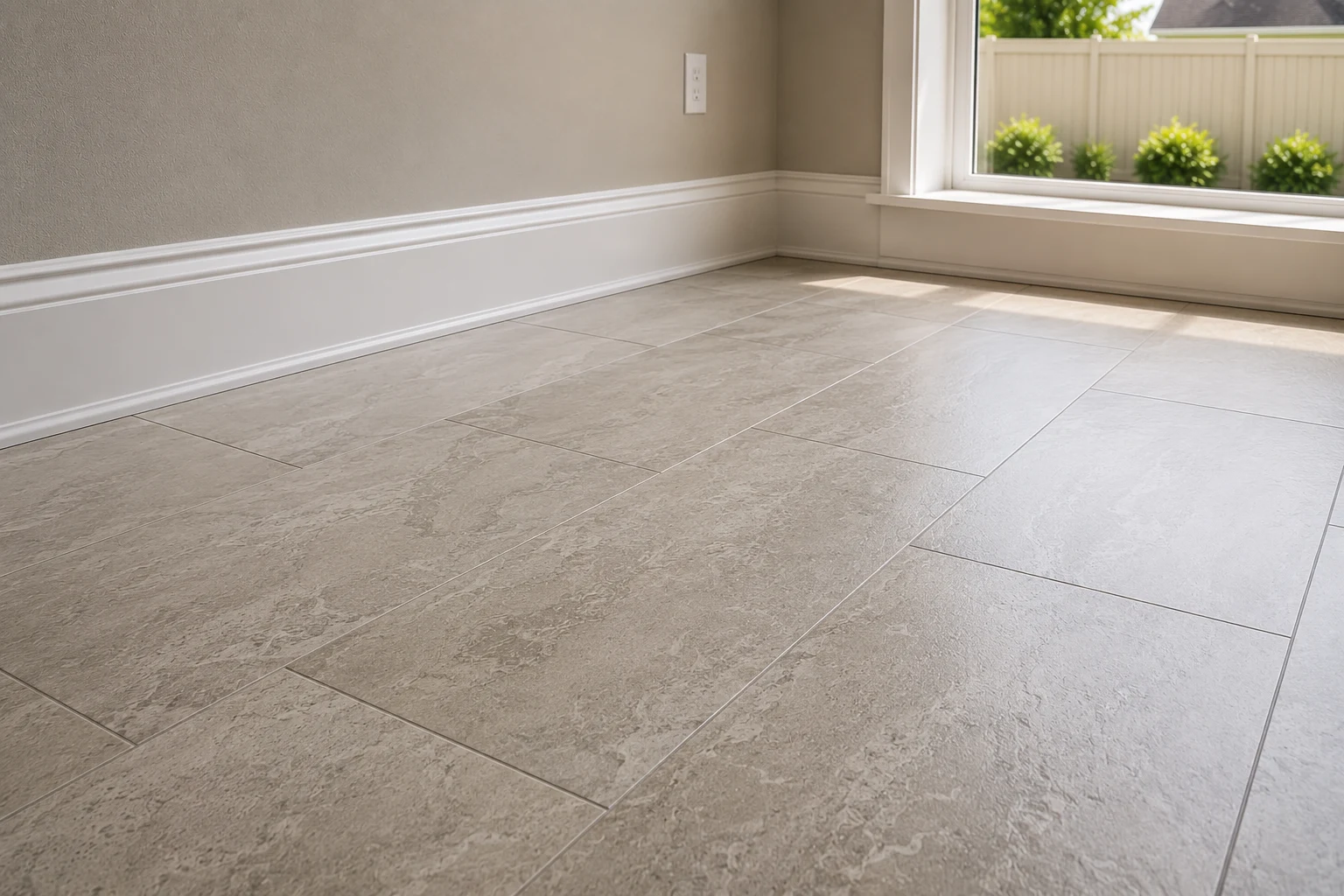
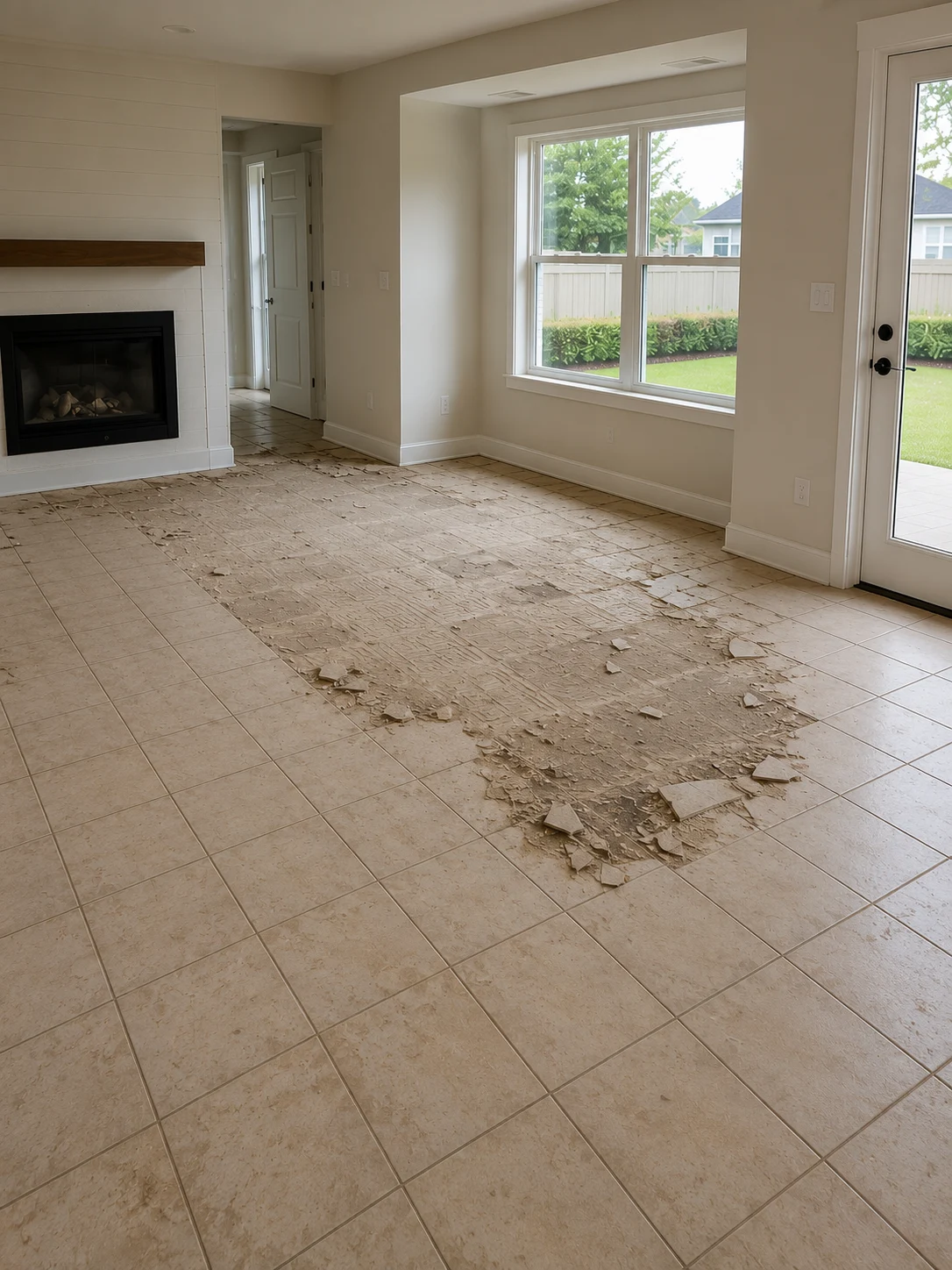
Tile is the fourth option in most Florida houses, and it plays a different role from the three above. Porcelain absorbs almost no water and shrugs off sand and claws, which is why it keeps its place at entries, in bathrooms and in rooms opening to a pool deck, at the cost of a harder, cooler and louder floor that needs a flatter slab. The trade-offs between tile and vinyl plank, room by room, are compared in porcelain tile versus vinyl plank.
Where water changes the answer entirely
If any part of the decision involves standing water rather than spills, the comparison stops being three-way. The behaviour of each core against water, and the honest difference between “waterproof” and “water-resistant” on a label, is covered in our guide to the most durable and waterproof flooring. In a house with a pool, that section decides more than this one does.
Where cost fits into the choice
Material price is the least reliable way to compare these three, because the installed price is driven by labour and preparation as much as by the product, and the labour differs between them. Glued-down engineered hardwood takes longer than click-together vinyl plank; both take longer over a slab that needs levelling.
The room-by-room mechanics of that are in our guide to flooring installation costs, and the practical advice from it applies directly here: get the same rooms quoted for two materials, with preparation broken out separately, rather than comparing shelf prices.
Deciding once, for the whole house
The most consequential version of this choice is not which material, but whether the floor runs continuously. A single material through the connected spaces removes transition strips, removes the batch-matching problem later, and makes an open plan read as one room — which is how most houses around Winter Garden and the newer parts of the region are laid out.
The cost of that decision is that the material has to be chosen for the most demanding room it passes through, not the average one. That is the real reason vinyl plank has taken so much of this market: it is the only one of the three that can run from the bedrooms through the kitchen to the back door without anyone having to argue about it.
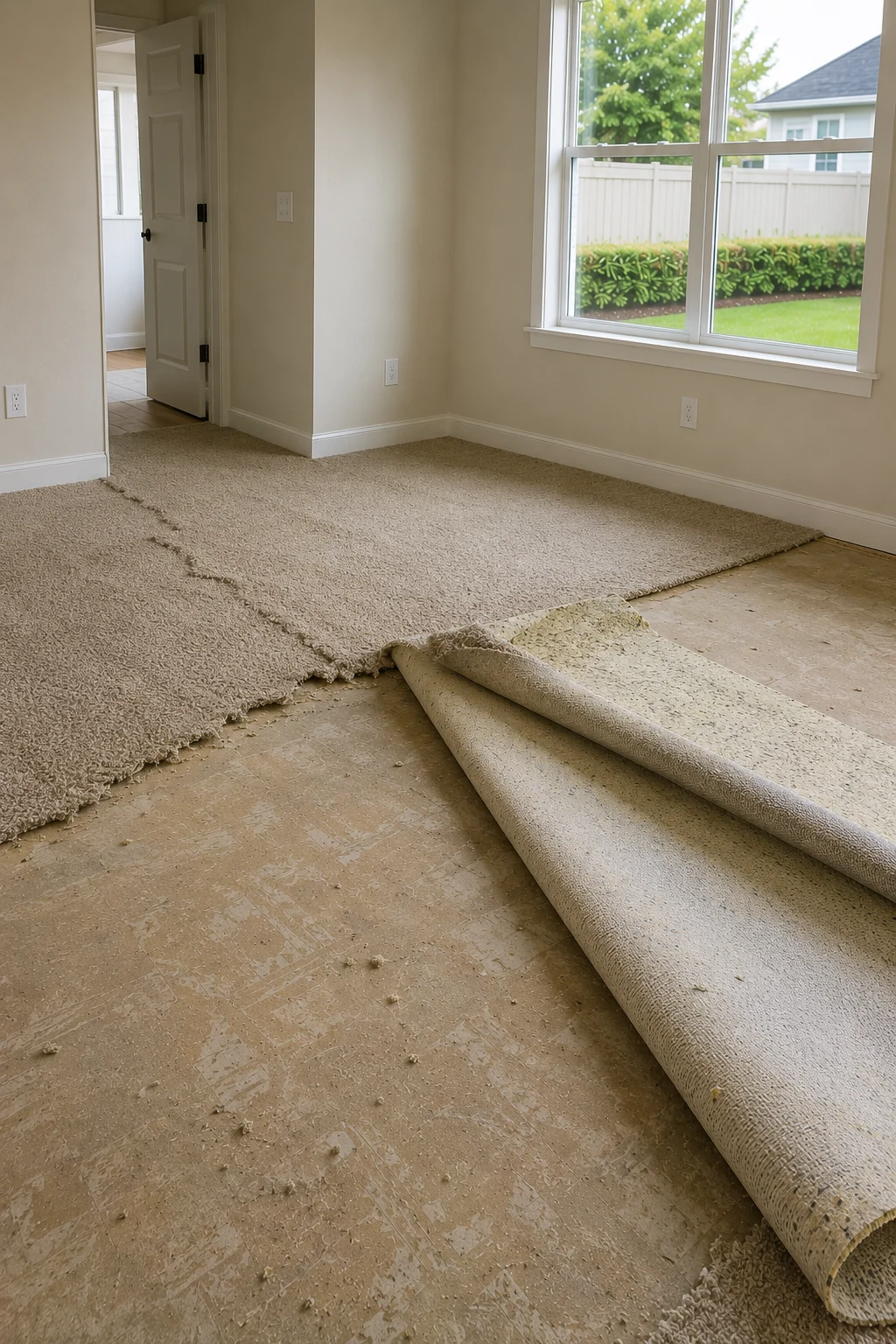
If the house is being renovated in stages rather than at once, decide the material for every room now even if only two are being done. Products are discontinued, batches change, and the transition you accept at a doorway today is permanent. That is a decision worth settling at the start of a broader home renovation rather than three years into it.
Share this article