The short answer
Luxury vinyl plank flooring lasts 15 to 25 years in a typical home, and entry-level product in a busy household can be worn out in 5 to 10. The range is that wide because lifespan is decided by three things: the thickness of the wear layer on top of the plank, how flat and dry the subfloor was on installation day, and how much sun, sand and standing water the floor lives with.
A 12 mil wear layer in a bedroom can still look new at year 20. The same plank in an entryway that collects pool water and sand can look tired by year 7. The product grade sets the ceiling; the installation and the conditions decide how close you get to it.
Key takeaways
- Most residential luxury vinyl plank keeps looking good for 15 to 25 years; entry-level product in a high-traffic home can be finished in 5 to 10.
- The wear layer, measured in mils, predicts durability. Total plank thickness predicts comfort and quiet — it is not the same specification.
- Subfloor preparation decides more than product choice: an uneven or damp slab will end a premium floor faster than foot traffic ever will.
- In Central Florida, tracked-in sand and direct sun through sliding doors do more visible damage than water does.
- LVP is replaced, never refinished, so the honest comparison against hardwood is one full replacement versus two or three sandings.
- Warranty length is a marketing figure with prorated fine print. It is not an estimate of how long the floor will look like new.
What “lifespan” really means for a vinyl floor
Ask three suppliers how long luxury vinyl plank lasts and you will get three different numbers, all technically true and none of them useful — because they are answering different questions. A floor can be structurally perfect and still look finished. It can look new in a guest room and worn out in the hallway ten feet away. Before any range means anything, it has to be split in two.
Structural life and cosmetic life are not the same thing
The plank itself is extremely durable. The rigid core, the click edges and the backing do not rot, do not swell the way laminate does, and are unaffected by the humidity a Central Florida home sits at all year. Structurally, most LVP will outlast the reason you eventually replace it.
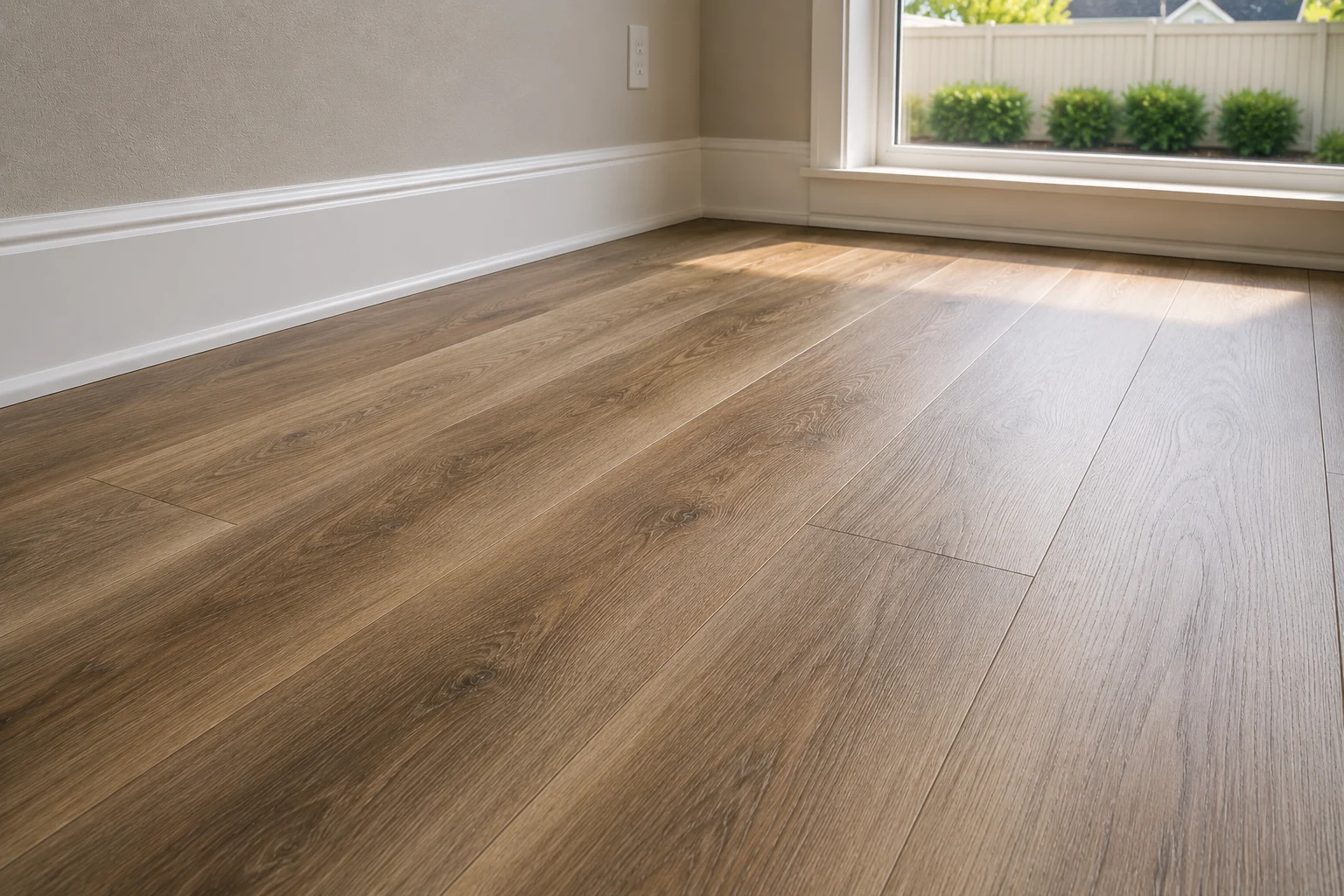
What wears out is the surface. Above the printed film that gives the plank its wood look sits a clear wear layer, and that layer absorbs every scratch, scuff and abrasive step. As it thins, the print underneath starts to lose depth, then dulls, then finally shows a visible traffic path from the door to the kitchen. The floor is still sound. Nobody wants to keep living with it.
So the honest question is not how long the plank survives. It is how long it keeps looking like the floor you paid for — and that is a wear layer question.
The wear layer is the number that predicts durability
Wear layers are measured in mils, thousandths of an inch. It is the single specification that most reliably separates a floor that reaches year 20 from one that disappoints at year 6, and it is almost always printed in small type while the overall thickness gets the headline on the display board.
Total thickness — 5mm, 6mm, 8mm — tells you how solid and quiet the floor feels underfoot and how forgivingly it bridges small imperfections in the subfloor. It tells you very little about how long the surface will hold up. A thick plank with a 6 mil wear layer is a comfortable floor that will wear quickly. A thinner plank with a 20 mil wear layer will still look presentable long after.
A warranty is a sales term, not a lifespan estimate
“Lifetime residential warranty” is one of the most misread phrases in flooring. Those warranties are limited, usually prorated after the first few years, and generally cover wear-through of the layer — meaning the print is actually gone, not that the floor looks tired. They also assume the manufacturer’s installation and maintenance instructions were followed exactly, which puts the burden of proof on the homeowner years after the fact.
What each grade of LVP realistically gives you
Once you know to look at the wear layer, the market sorts itself into four fairly clean tiers. The ranges below are practical estimates for ordinary household use rather than the figures printed on a warranty, and they assume a properly prepared subfloor.
| 6–8 mil | 12 mil | 20 mil | 28 mil and up | |
|---|---|---|---|---|
| Usually sold as | Entry level, rental grade | Standard residential | Premium residential | Light commercial |
| Suited to | Closets, guest rooms, low-traffic spaces | Bedrooms, living rooms, most of a home | Kitchens, hallways, entryways, whole home | Short-term rentals, large dogs, home offices with chair casters |
| Realistic look-good life | 5–10 years | 10–20 years | 20–25 years | 25 years or more |
| How it usually gives up | Print wears through along traffic paths | General dulling and fine scratching | Impact dents appear before surface wear does | Seams and edges age before the surface does |
| Cost impact on a whole-home project | Baseline | Modest step up | Noticeable step up | Largest step up |
The practical conclusion for most homeowners is simple: when the budget is tight, put the money into the wear layer before you put it into plank thickness, and put it into the rooms that actually take traffic. There is nothing wrong with running a standard residential grade in bedrooms and stepping up in the entry, kitchen and main hallway — as long as the same collection is used throughout so the colour and the plank height match at the doorways. Short-term rentals are the case where the top tiers earn their cost, for the reasons in choosing flooring for a vacation rental.
What decides where your floor lands in that range
Two identical floors installed in two homes in the same week can be five years apart in appearance by year ten. These are the variables that separate them, roughly in order of how much they matter.
The subfloor underneath it
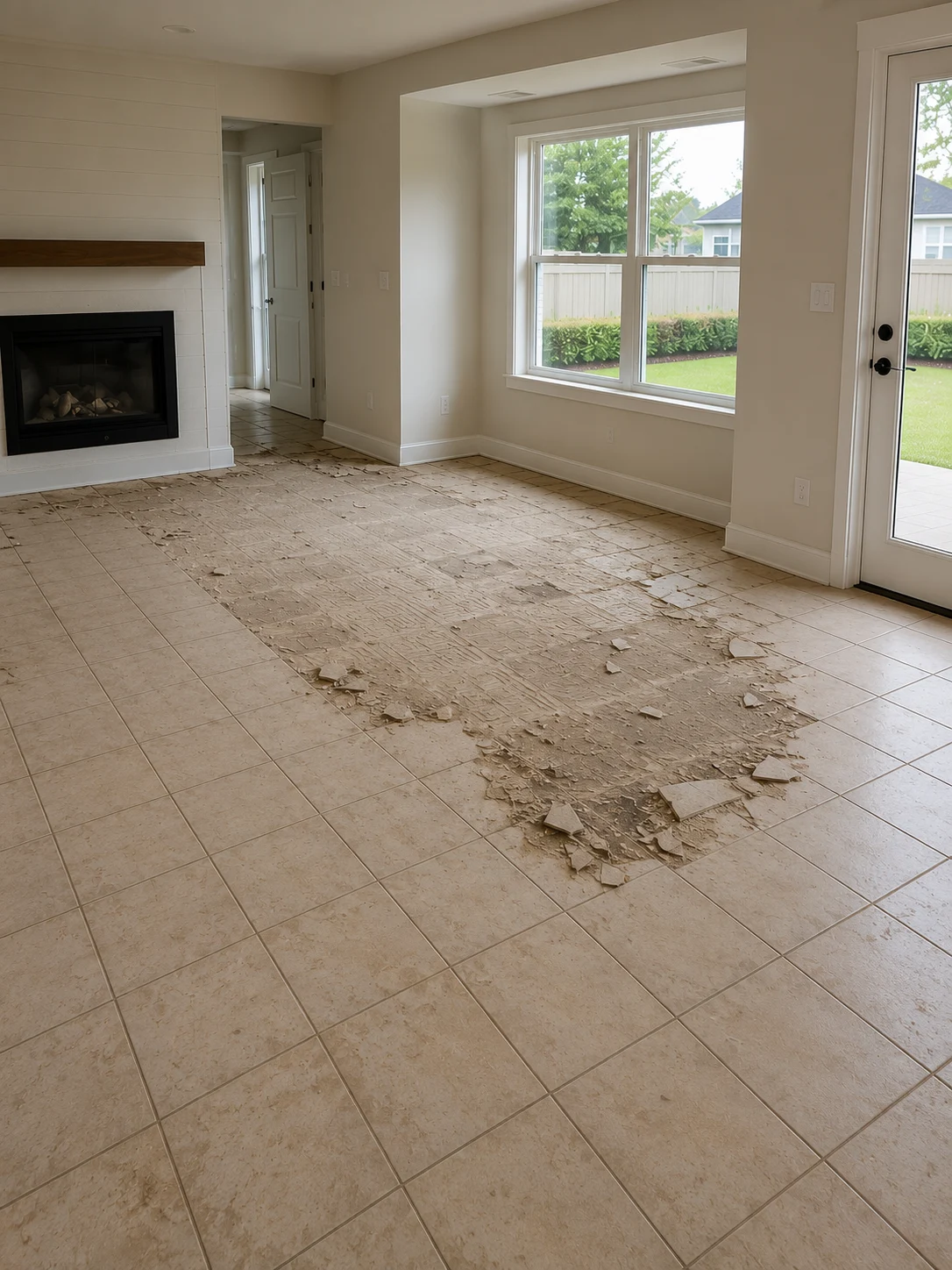
This is the one that decides more than the product does, and it is the one nobody can see once the job is done. Most manufacturers require the substrate to be flat within about 3/16 of an inch over ten feet. A slab with more deviation than that leaves the plank unsupported in the low spots, and every step flexes the click joint that is bridging the gap. Joints that flex eventually separate, click edges eventually chip, and the floor develops the hollow sound and the small seam gaps that owners usually blame on the material. How a slab is brought within tolerance is covered in preparing and levelling a slab.
Slab-on-grade construction adds a second issue that is specific to our market: moisture moving up through the concrete. Vinyl is not damaged by that moisture, but adhesive is, and vapour that cannot pass through a waterproof floor will find the perimeter and the seams instead. On a glue-down installation over a slab, moisture testing is not an optional formality — it decides which adhesive and which underlayment are appropriate. The tests and the readings manufacturers accept are explained in how a concrete slab is moisture-tested.
This is why proper preparation, not the material invoice, is where a flooring project is won or lost. Grinding a high spot, filling a low one and dealing with old adhesive residue is unglamorous work that adds a day and buys a decade.
Sun, heat and expansion
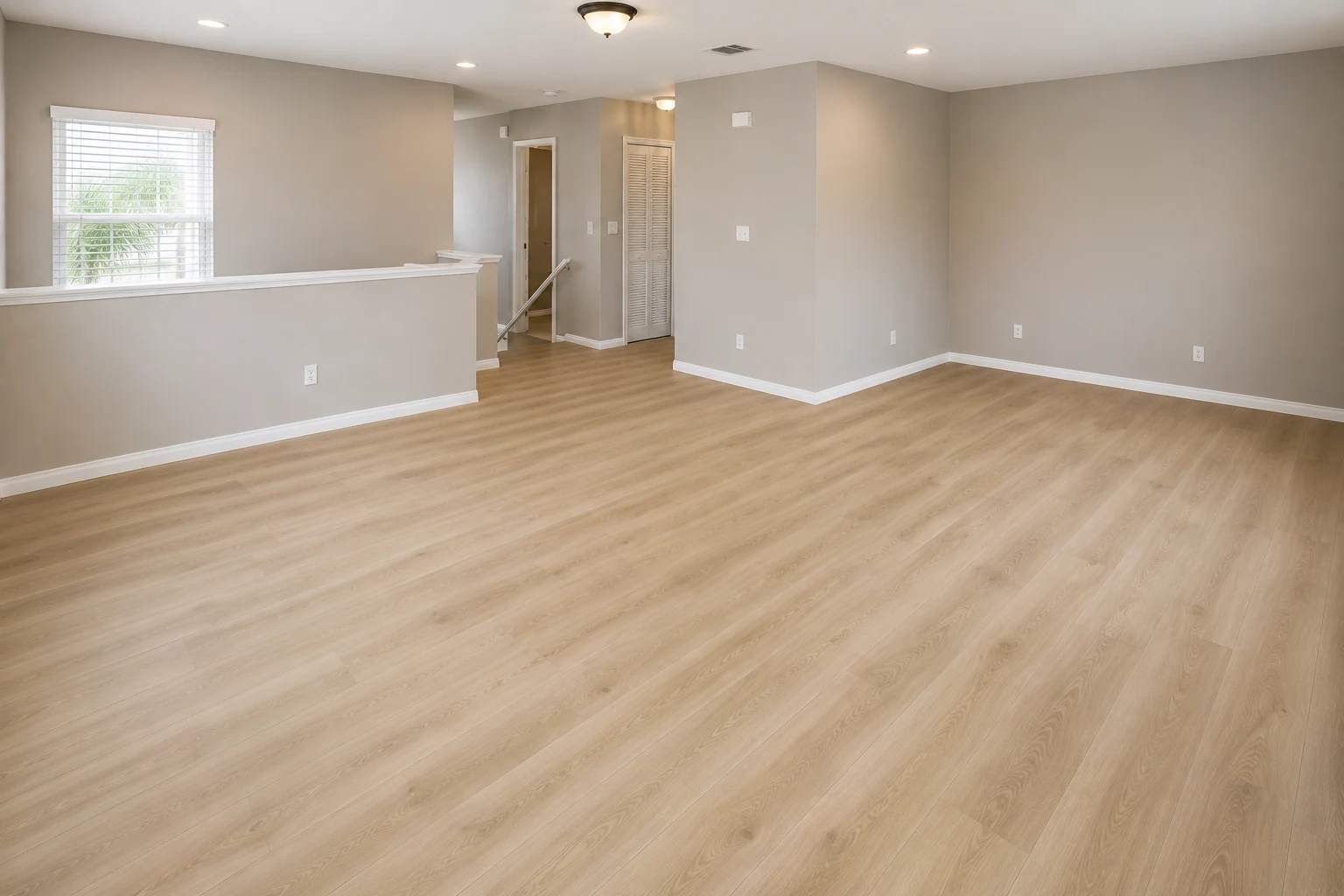
Vinyl expands and contracts with temperature more than wood does. In most of the country that is a footnote. In a Florida room with a west-facing slider and no window film, a floating floor can reach surface temperatures far above room temperature every afternoon, expand against a baseboard that was installed tight, and either lift slightly at the seams or gap when it cools.
Three things prevent it, and all three are decisions made before installation: an expansion gap of the size the manufacturer specifies around the entire perimeter and around every fixed object, solar-control film or a permanent shading solution on the worst-exposed glass, and a glue-down installation in the rooms with the most extreme exposure. A glued floor cannot move as a sheet, which is exactly why it is the right choice for sunrooms and for spaces that connect directly to an outdoor living area with a large glazed opening.
It is also worth stating plainly: interior LVP does not belong in an unconditioned space. A garage that has not been climate-controlled, an open lanai or a screened porch that swings 40 degrees between night and afternoon will fail the floor and void the warranty at the same time. Where a garage remodeling project turns the space into a conditioned room, LVP becomes a reasonable choice — but the conditioning has to come first.
Water, humidity and what “waterproof” actually covers
Nearly every LVP sold today is waterproof, and that claim is accurate about the plank. It is not a claim about the assembly. Water that reaches a floating floor’s seams — a dishwasher that leaks quietly for a week, a slider left open during an afternoon storm, a toilet supply line — passes down through the click joints, sits on the subfloor and has nowhere to evaporate. The planks are unharmed. The plywood, the underlayment and anything organic under them are not.
In practice this matters most in the three rooms that generate water: the kitchen, the laundry and the bathroom. It is not an argument against LVP in any of them — it remains one of the best choices available for all three — but it is an argument for a glue-down installation in wet areas, for silicone at the perimeter where it belongs, and for treating an appliance leak as an emergency rather than as a mopping job.
Everyday humidity is a non-issue. A conditioned Florida home stays in a range vinyl does not care about, which is precisely why LVP took over from laminate here.
Sand, grit, pets and furniture
This is the one that quietly does the damage. Fine sand tracked in from a driveway, a beach trip or the deck around a custom pool behaves like sandpaper underfoot, and abrasion is what actually consumes a wear layer. Nothing else on this list is as easy to control or as commonly ignored.
Large entry mats at every exterior door, a no-shoes habit in the main traffic path, and a weekly pass with a vacuum on the hard-floor setting will add years to the floor. Furniture is the second half of it: felt pads under every leg, replaced when they flatten, and hard-wheel chair casters swapped for soft ones or set on a mat. Pet claws mark a 6 mil wear layer and barely register on a 20 mil one, which is the practical reason households with large dogs are better served by moving up a tier than by trimming nails more often.
One less obvious risk: rubber. Rubber-backed mats, some furniture feet and vehicle tires can permanently stain vinyl through a reaction with the plasticizers in the plank. The mark does not clean off. Use mats specifically rated for vinyl floors.
Floating or glued down
Most residential LVP is installed as a floating click-lock floor: it is faster, cheaper, tolerant of minor slab movement, and easy to repair from a wall. Glue-down costs more in labour and preparation, but the floor cannot move as a sheet, handles heat and sun better, feels more solid underfoot and is easier to repair in the middle of a room.
The decision is per-project rather than per-preference. Large uninterrupted open-plan areas, rooms with heavy sun exposure, wet rooms and homes with very heavy furniture lean towards glue-down. Bedrooms, smaller rooms and slabs with imperfections that are being covered rather than corrected lean towards floating. On a whole home remodeling project it is entirely normal to use both methods in the same house, with the same product, for exactly these reasons.
LVP against the alternatives over a twenty-year window
Lifespan on its own is a misleading way to compare flooring, because the materials fail differently and cost differently to recover. Twenty years is a fairer frame.
| Luxury vinyl plank | Engineered hardwood | Porcelain tile | Laminate | Carpet | |
|---|---|---|---|---|---|
| Typical service life | 15–25 years | 20–40 years | 30+ years | 10–20 years | 5–10 years |
| Can it be renewed? | No — replaced, not refinished | Yes, once or twice depending on veneer | Not needed; grout can be renewed | No | No |
| Standing water | Plank unaffected | Damages the floor | Unaffected | Swells and delaminates | Requires replacement |
| Scratches and dents | Resists scratches; dents under sharp impact | Scratches and dents visibly | Very resistant; can chip | Resists scratches; chips at edges | Not applicable; crushes and mats |
| Comfort and noise | Warm and quiet | Warm, moderately quiet | Hard and cold, echoes | Hard, often noisy | Warmest and quietest |
| Twenty-year reality | One replacement near the end of the window | One or two refinishes, original floor intact | Same floor, possibly regrouted | One or two replacements | Two to four replacements |
Read that table honestly and LVP is neither the cheapest nor the longest-lived option. What it is, consistently, is the one with the fewest bad outcomes: it does not swell, it does not need refinishing, it does not go cold underfoot, it does not have to come out after a leak, and it is the only material on the list that is genuinely comfortable in a Florida living room and appropriate in a Florida bathroom at the same time. That is why it has become the default choice in so many homes across Orlando, Winter Garden and Lake Nona.
How to tell a floor is nearing the end
Wear arrives gradually enough that most people stop seeing it. These are the signals that a floor is genuinely at the end of its useful life rather than simply dirty:
- A visible traffic path that reads lighter or duller than the rest of the room in raking afternoon light, and does not change after cleaning.
- Loss of texture. Embossed grain that you can no longer feel with a bare foot in the main walkway means the wear layer there is largely gone.
- Colour showing through. Grey or white patches in the pattern are the print itself wearing away — the point at which repair stops being an option.
- Seams that have opened and stayed open across several rows, especially if they reappear after being closed. That usually indicates movement or a substrate problem rather than plank failure.
- Edges lifting or curling, most often near a sunlit slider or a room that has had a slow leak.
- Persistent hollow sound underfoot in the same spots, which points to the subfloor beneath rather than the floor above.
The first three are cosmetic and predictable — the floor has simply done its job. The last three are worth investigating before replacing anything, because installing a new floor over the same unresolved cause produces the same result on a shorter schedule.
Getting the full life out of a new floor
Almost everything that shortens a vinyl floor’s life is decided in the first month or repeated weekly. Neither takes much effort once it is set up.
The first month
Let the planks acclimate in the conditioned house for the period the manufacturer states before installation begins. Confirm that expansion gaps exist at every wall and every fixed object, and that they are covered by baseboard or quarter round rather than pinched by it — this is also the natural moment to handle any interior painting or trim work, since the trim is off and the room is empty. Lift furniture in rather than dragging it, fit felt pads before anything is set down, and give a glue-down floor the full cure time before rolling loads return.
The routine that actually matters
- Vacuum or dry-mop weekly, more often in the entry areas, using a hard-floor setting with the beater bar off.
- Damp-mop with a cleaner approved for vinyl. Steam mops, wax, oil soaps and abrasive pads all damage the wear layer or leave a film that dulls it.
- Keep a large mat at every exterior door and one at the door from the garage, since that is where the most grit comes from.
- Replace felt pads once a year, or as soon as one flattens. A flattened pad collects grit and turns into a cutting tool.
- Manage the sun with blinds or window film on the exposures that get direct afternoon light.
The repairs worth making immediately
Fix a leaking appliance or supply line the day you find it, not the week you find it. Replace a chipped or gouged plank while the collection is still available and the damage is limited to one board. Re-caulk a bathroom or kitchen perimeter as soon as the silicone starts to separate. Every one of these is a small job that becomes a floor replacement if it is left alone — and small jobs of exactly this kind are what home services visits exist for.
When replacing beats repairing
There is a point where continuing to patch a floor costs more than finishing it, and it is easier to identify than most people expect. Replace rather than repair when the wear is general rather than local — a whole-room dulling cannot be spot-fixed. Replace when the original collection is discontinued and a matching plank no longer exists, because a visible patch in the middle of a living room is a permanent compromise. Replace when the seams are opening in more than one area, which is a substrate message rather than a plank message. And replace when the floor is being changed for a reason that has nothing to do with wear — a new layout, a wall coming out, or a kitchen that no longer matches the floor it sits on.
That last case is the most common reason of all, and it is worth planning for deliberately. Flooring is one of the few elements of a house that touches every room, so it is almost always cheaper and always better looking to replace it as part of a larger project than as an isolated job a year later. If a remodel is anywhere on the horizon, the floor decision belongs in that conversation rather than ahead of it.
Share this article