The short answer
Waterproof and water-resistant are not two grades of the same thing. Waterproof describes a material whose core will not swell or degrade from contact with water — rigid-core vinyl plank and porcelain tile are the two that genuinely qualify. Water-resistant describes a surface that holds water off for a stated number of hours, which almost always means a product with a fibreboard core underneath it.
Neither word describes the installed floor. Water that reaches a seam, a perimeter gap or a doorway transition passes through and sits on the substrate, where it does the actual damage. In a Florida house on a concrete slab, that trapped moisture dries slowly and shows up later as adhesive failure, cupping at the edges or an odour nobody can locate.
For a household with dogs and children, the honest ranking is porcelain tile first for pure resistance, rigid-core vinyl plank first for liveability, and wood or laminate only where exposure is genuinely low. But the wear layer, the perimeter detail and the condition of the substrate decide more about how the floor ages than the category on the box.
Key takeaways
- Waterproof is a property of the plank. Watertight is a property of the installation, and only the second one protects the subfloor underneath.
- Porcelain tile has a real definition behind it: no more than 0.5 per cent water absorption under ANSI A137.1, tested to ASTM C373. Ceramic and water-resistant laminate have no equivalent.
- Pet durability is three separate problems — claw scratches, traction when wet and liquid reaching the seams. No single material wins all three.
- Polished large-format tile is the hardest floor to scratch and the worst for an older dog, because traction drops sharply when it is wet.
- A scratch in wood is in the finish and can be refinished. A scratch in vinyl plank is permanent, but a single plank can be replaced if you kept the spare box.
- In Central Florida the abrasive that wears floors is tracked-in sand, not water. The entry from the pool deck does more damage than any spill.
Understanding Waterproof vs. Water-Resistant Flooring
The two terms are used as though they were adjacent points on a scale, with waterproof simply being the better version. They are not. They describe different things, and only one of them has a measurable definition behind it.
The confusion is expensive because it leads people to buy a floor that is genuinely waterproof and then assume the room is protected. It is not, and understanding why is worth more than any product comparison.
What each word actually claims
Waterproof, as used on a flooring label, is a claim about the material itself: the core will not swell, warp, delaminate or degrade from contact with water. Rigid-core vinyl plank and porcelain tile both qualify. It is a claim about the plank in your hand, not about the floor once it is installed.
Water-resistant is a claim about the surface holding water off for a stated period. It is applied almost exclusively to products with a fibreboard core — laminate, and some engineered wood — where the core will swell permanently once water reaches it. The claim is real, but it is a spill-response window, not a property of the material.
Only one of these has an independent definition. Porcelain tile is defined in ANSI A137.1 as ceramic tile with a water absorption of no more than 0.5 per cent, measured by the test methods in ASTM C373. That is a number a laboratory can verify. Rigid-core resilient products — the SPC and WPC constructions sold as waterproof vinyl plank — are specified under ASTM F3261, which sets out the testing a product in that category has to meet. Neither “waterproof” nor “water-resistant” is itself a regulated term, which is precisely why the underlying specification matters more than the word on the box.
The three layers water has to get through
A floor is not one thing. It is a stack, and water is stopped or not stopped at three different points:
| Layer | What it does | How it fails |
|---|---|---|
| Surface | Sheds water and resists staining | Wears through, scratches, loses coating |
| Seams and perimeter | Should slow water reaching below | Click joints, expansion gaps, transitions |
| Substrate | Carries the floor and must stay dry | Absorbs and holds water, releases adhesive |
The point of reading it as a stack is that a waterproof surface only addresses the first row. Every floating floor has an expansion gap around its entire perimeter, hidden by the baseboard, because the floor has to be free to move. That gap is an opening. Doorway transitions are another. A floor can be completely waterproof as a material and still deliver water to the substrate within minutes.
Where the water goes once it is past the floor
Underneath is where the damage happens, and it is slow and invisible. Water spreads across the substrate, wicks into anything absorbent, and in a Florida house on a concrete slab it dries very slowly, because the slab is cool, the humidity is high and there is no air movement under the floor.
The consequences show up weeks later rather than immediately: an adhesive that has released so the floor sounds hollow, edges that have cupped where a wood or laminate product met the moisture, or a persistent smell that nobody can trace to a room. This is also why the standard advice after any significant leak is to lift the floor rather than to dry the surface.
The Most Durable Flooring for Dogs and Pets
“Good with pets” is treated as a single property in most flooring conversations, and it is really three problems that pull in different directions. A material that solves one of them often makes another worse.
The three problems, separated
Scratching is the first and the one everybody thinks of. It is a question of the hardness and thickness of the surface layer, and of how visible a scratch is once it happens.
Traction is the second, and it is almost never discussed even though it matters more to the animal. Hard, smooth floors give dogs very little grip, and for an older or arthritic dog a polished surface makes moving around the house genuinely difficult. It is the one criterion where the most scratch-proof floor is the worst choice.
Liquid is the third, and it is not solved by a waterproof plank. A pet accident that reaches a seam or a grout line and is not found immediately becomes a staining and odour problem in the layer below, which is the part that cannot be cleaned.
What actually resists claws
Porcelain tile is effectively immune. Claws do not mark it, and this is the honest reason it keeps appearing in households with large dogs despite everything else about it.
On rigid-core vinyl plank, resistance is set by the wear layer, measured in mils, and by the coating on top of it. The relationship between that number and how the floor ages is the subject of our guide to how long luxury vinyl plank lasts, and it applies directly here: the same product family spans a wide range of resistance depending on that single specification.
On wood, the important distinction is that a scratch is normally in the finish rather than in the timber. That makes it repairable — and it is the one advantage wood retains in a household with animals, because a floor that can be refinished can be reset to new. Matte finishes, wire-brushed textures and busier grain hide marks well, but hiding and preventing are different things and should be described honestly by whoever is selling the floor.
The traction problem nobody mentions
Large-format polished porcelain is the slipperiest common residential floor, and its traction drops sharply when it is wet — which, in a house where a dog comes in from a pool deck, is often. Matte and textured finishes grip considerably better, and a smaller tile format adds grout lines, which add texture.
The practical fix is usually placement rather than product: runners on the routes the animal actually uses, and a rug with a grippy pad where dogs turn or take off. It is worth deciding this before choosing a tile finish rather than after watching a dog struggle on it.
Sand is the real abrasive in a Florida house
Water is the problem people plan for and sand is the one that wears the floor. Tracked-in sand acts as an abrasive under every footstep, and in Central Florida it arrives from the pool deck, the lanai and the beach in quantities that no other region deals with.
This is a particular pattern in the newer open-plan houses around Horizon West, where a slider from the living space to the pool deck means the busiest floor in the house is also the one closest to the water. Matting at that door, a rinse point outside it and a routine that keeps grit off the floor extend the life of any material more than upgrading the product one tier would.
Engineered for Moisture: Waterproof LVP and Tile
Two materials genuinely do not care about water, and the choice between them is not really about performance. It is about how you want the floor to feel and how you want it repaired.
The four options compared on what matters
| Rigid-core vinyl plank | Porcelain tile | Water-resistant laminate | Engineered wood | |
|---|---|---|---|---|
| Core in standing water | Unaffected | Unaffected | Swells permanently | Swells at the core |
| Independent specification | ASTM F3261 | ANSI A137.1, absorption ≤0.5% | Manufacturer claim only | Manufacturer claim only |
| Claw and scratch resistance | Set by wear layer thickness | Highest of the four | Hard surface, chips at edges | Lowest, but refinishable |
| Traction when wet | Good | Poor if polished, good if textured | Moderate | Moderate |
| How damage is repaired | Replace individual planks | Replace individual tiles | Replace planks, matching is hard | Refinish the whole floor |
| Underfoot | Warm, quiet, some give | Hard, cool, echoes | Hard, can sound hollow | Warm and quiet |
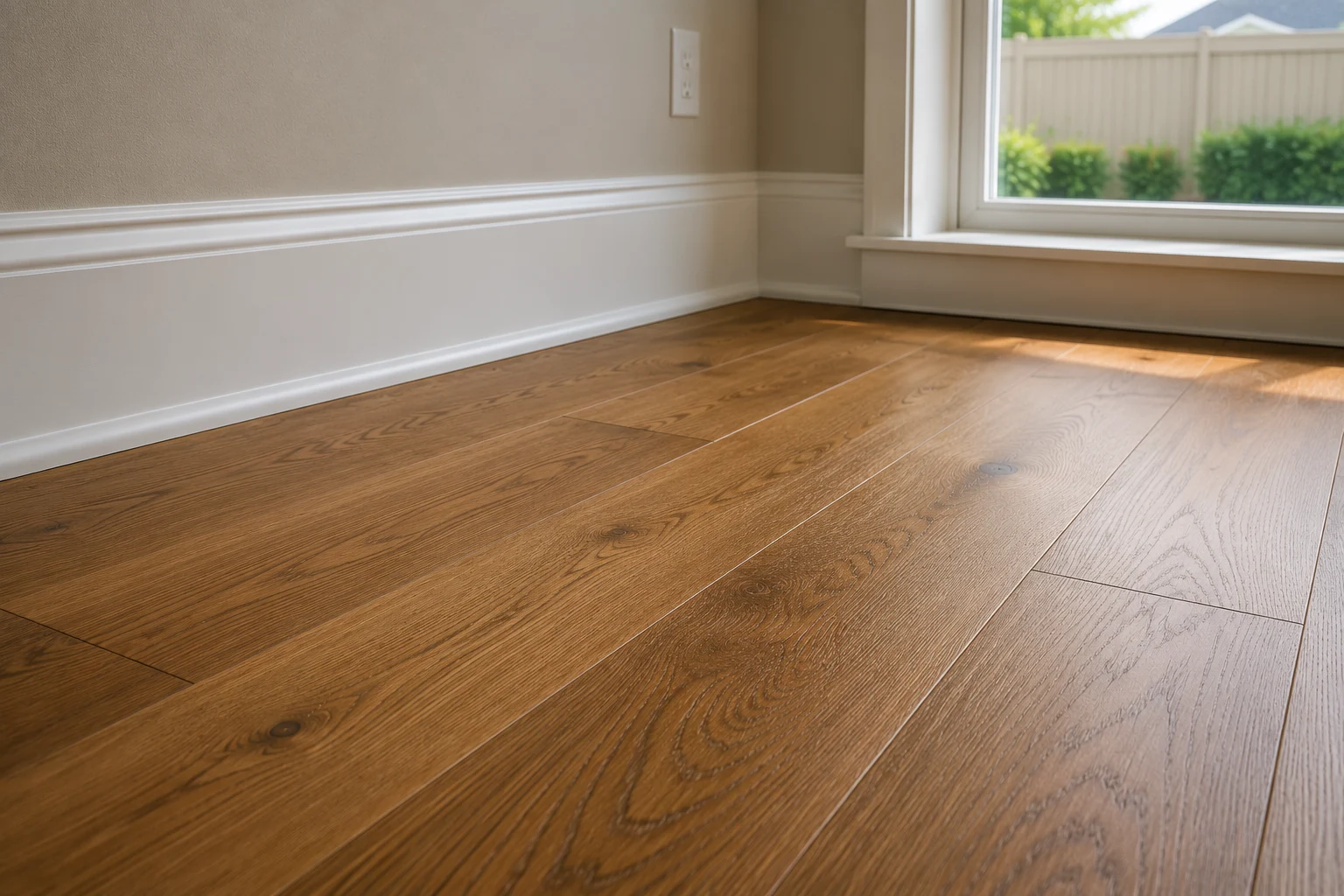
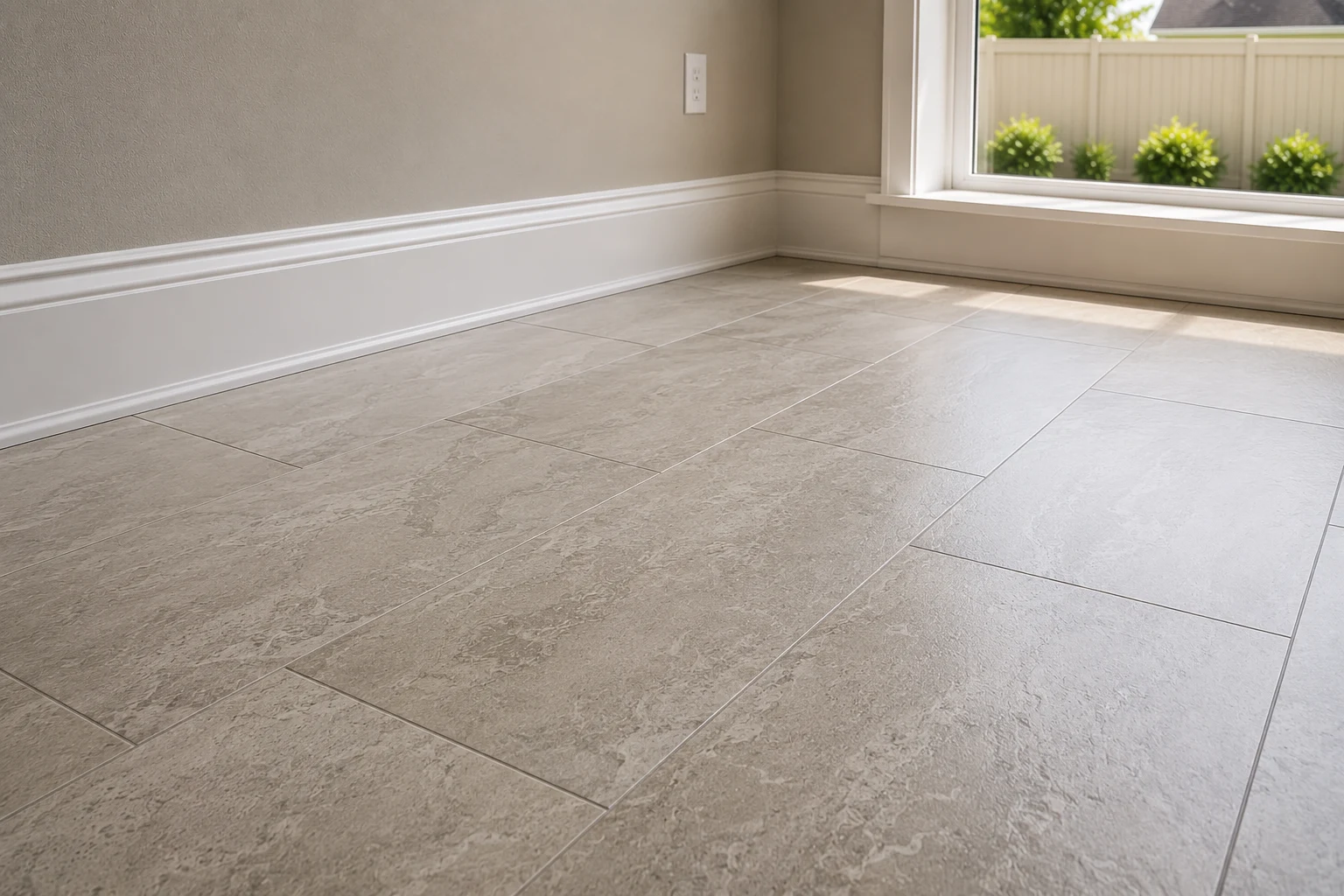
Reading it by scenario: porcelain tile wins where exposure is genuinely high and the household will accept a hard, cool, loud floor — wet rooms, entries from outside, and houses with large dogs. Rigid-core vinyl plank wins almost everywhere else in an active home, because it gives up very little on water and claws while being warmer, quieter and far more forgiving of a substrate that is not perfectly flat. Water-resistant laminate makes sense only in genuinely dry rooms where the budget is the binding constraint. Engineered wood is a choice made for how it looks and how it can be refinished, and it should be kept away from the rooms where water is a realistic event. The two floors that genuinely do not care about water are compared head to head in porcelain tile or vinyl plank for a Florida home.
What “waterproof engineered” means on a wood product
Products described as waterproof engineered flooring pair a wood veneer with a core intended to resist moisture, sometimes with sealed edges. The claims are real but they are manufacturer claims rather than an industry specification, and they are usually bounded by warranty conditions about how long water may remain and how the floor is maintained.
The part that does not change is the top. It is still a wood veneer, so it responds to prolonged wetting the way wood does, and it can still be marked by claws. The honest description of most of these products is highly water-resistant rather than indifferent to water, and they are best understood as a way to get wood into a room where a conventional wood floor would be a mistake — not as an alternative to tile in a wet area.
Installation decides more than the product
Three details do more for the water performance of a finished floor than the difference between two good products.
The perimeter is the first. A floating floor needs its expansion gap, but in rooms where water is likely the gap can be closed with a flexible sealant at the base of the wall and behind the baseboard, which stops surface water from reaching the substrate without restricting the floor.
Transitions are the second. Doorways between a wet room and a dry one are where water crosses, and a properly detailed transition with a sealed edge is a small cost at installation and an expensive retrofit afterwards. Transition profiles and heights are covered in the guide to baseboards and transitions.
The substrate is the third and the largest. Moisture testing before installation is not optional over a Florida slab, and correcting flatness before the floor goes down is what determines whether seams stay tight enough to resist water at all. Both are also the least predictable part of a quote, for the reasons set out in our guide to flooring installation costs.
Match the floor to the exposure, not to the room name
The most reliable way to choose is to grade each area by what will actually happen on it rather than by what the room is called.
Areas with a realistic risk of standing water — the entry from a pool deck, a laundry, anywhere a supply line runs — should get a material whose core is genuinely unaffected by water, installed with sealed perimeters. Areas with splash and spill exposure, which includes most kitchens, need a waterproof core but not a wet-area detail; the practical concern in a kitchen is a slow appliance leak rather than an event. Dry areas can take whatever suits the room, because the water question is not the deciding one there.
One caution about running a single material everywhere for the sake of continuity: it is a good instinct, and it is the right answer more often than not, but it means the material has to be chosen for the worst exposure in the house rather than the average one. That is usually how a household with a pool, a dog and an open plan ends up with rigid-core plank throughout and tile at the two doors that matter — a decision worth making with a flooring estimator who has seen the actual thresholds rather than a floor plan.
Share this article