The short answer
Hire the contractor who can show licensed, insured, inspected bathroom work in houses like yours, and who will put the shower waterproofing system in writing by name. Those two things predict how a bathroom performs in year five far better than price, showroom quality or how quickly the quote arrived.
The plumber-or-contractor question is settled by scope rather than by preference. A licensed plumber is the right call when only fixtures, valves, drains or a water heater are involved. Once tile, waterproofing, framing, electrical or a moved fixture enter the job, the bathroom becomes a multi-trade project and someone has to own the sequence, the permit and the inspections.
Verify before you shortlist, not after you like someone. Licence status, insurance and permit history are all checkable without asking the contractor for anything, and every one of them is faster to check than a quote is to read.
Key takeaways
- Verify the licence and the insurance before the first site visit, not after the quote arrives. Both are checkable without asking the contractor.
- A plumber and a general contractor are not competing options. They cover different scopes, and the split decides who owns the shower assembly.
- The quote has to name the waterproofing system and the shower substrate. A quote listing only tile and fixtures has not described the part that fails.
- Never pull the permit yourself on a contractor's behalf. The name on the permit is the name responsible for the work and for the inspections.
- References are worth more at eighteen months than at handover. Ask to see a bathroom that has been in daily use for at least a year.
- One contract over the whole wet area gives a leak one owner. Two separate contracts turn the same leak into a dispute between them.
Finding Reliable Bathroom Renovation Companies
Most shortlists are built from whoever appears first in a search and whoever a neighbour used. Both are reasonable starting points, and neither answers the question that decides the outcome: has this company finished bathrooms — plural — in houses like yours, and what do those bathrooms look like now rather than on handover day.
A bathroom is the least forgiving room to get wrong, because the part that fails is the part you cannot inspect once the tile is on. That changes what a shortlist is for. You are not looking for the company with the best photographs; you are looking for the one whose work has already survived a few years of daily use. That is a different search, and the useful sources for a bathroom remodeling shortlist are mostly not the ones that advertise.
Where a shortlist actually comes from
Four sources produce better names than a search page, and three of them are free.
Building department records are the strongest and the least used. Permits are public record, and in most jurisdictions they can be searched by address or by contractor, which tells you who pulls permits in your area, how often, and whether the inspections passed. A company with a long, clean permit history in your municipality has already proved the part of the process that homeowners cannot verify any other way.
Neighbours with completed work of the same type are the second. Ask specifically about bathrooms rather than about remodeling in general — a company that builds beautiful kitchens is not automatically good at wet areas, because the failure modes have nothing in common.
The third is the housing stock itself. In established neighbourhoods such as Winter Park, where original mid-century bathrooms are still in service, ask for references from houses of the same era. Cast iron waste lines, galvanised supply, undersized venting and lath behind the tile are all normal there, and a crew that has met them before does not price them as a surprise.
The fourth is the trade supply house. The counter staff at a plumbing or tile supplier see which companies buy proper materials, which ones return them, and which ones are known by name to the people who sell them.
What to verify before the first site visit
Licence and insurance are checkable without contacting the contractor at all, which is exactly why they should be checked first rather than at contract stage.
Florida licenses construction trades at state level through the Department of Business and Professional Regulation, and licences can be looked up online. Two details matter for a bathroom. Plumbing is licensed separately from general construction, so a plumbing licence does not authorise a whole-bathroom rebuild and a general licence does not make someone a plumber. And Florida distinguishes contractors certified at state level from those registered to work in a specific local jurisdiction, so a valid licence is not automatically valid in your city or county. Some jurisdictions also add a local registration step, which is worth confirming with the building department where the work will happen.
Insurance is verified the same way: from the source. Ask for a certificate of insurance issued directly by the insurance agent rather than a copy forwarded by the contractor, and check that general liability and workers compensation are both present and that the dates cover your project. Workers compensation deserves particular attention in construction, where the requirement is stricter than in other industries and where owners and officers can hold exemptions. If an uninsured worker is injured in your bathroom, the question of whose insurance responds is not one to resolve afterwards.
How to read reviews and references
Scores are close to useless in this category because almost everyone has good ones. Patterns are not.
Read for the same complaint appearing across several reviews rather than for the average, and read the negative ones for how the company responded rather than for what went wrong. Every remodeling project of any size has a problem in it. What separates companies is what happened next.
References are more valuable the older they are. A reference from last month tells you the sales process worked. A reference from eighteen months ago tells you whether the grout is still intact, whether the fan is loud, whether the shower door still closes and whether anyone came back when something needed attention.
Four questions get more out of a reference than any general enquiry. Was it the same crew from start to finish? What was found when the walls opened, and how was that priced? How long was it between the bathroom looking finished and being finished? And would you use them again specifically for a wet area?
The signals that end a conversation early
Some behaviours are worth treating as disqualifying rather than as negotiating points.
A quote consisting of one page and one number, with no scope stated, cannot be compared to anything and cannot be enforced later. A price that expires at the end of the visit is a sales technique, not a market condition. A refusal to visit the house before quoting means the number was produced without seeing the room it applies to.
Two more are specific to the way construction is paid for. A deposit that is large relative to what has actually been ordered or scheduled deserves a direct question about what it buys — Florida law places obligations on a contractor who takes a deposit above a defined share of the contract price, including deadlines to apply for the permit and to begin work, and the current requirement is worth confirming rather than assuming. And any suggestion that you pull the permit yourself, or that the job is small enough not to need one, is the point at which the conversation should stop.
Questions to Ask Your General Contractor
Lists of questions to ask a contractor are easy to find. What is missing from almost all of them is the answer key: knowing what a solid reply sounds like, and what a fluent but empty one sounds like.
The questions that reveal how the job will be run
Eight questions cover most of what you need, and they are about operations rather than about design.
Who is physically in my house each day, and are they employees or subcontractors? Who supervises them, and how often is that person on site? What is the sequence of work and where are the waiting periods in it? What waterproofing system will be used in the shower, by name? Who applies for the permit and which office issues it? How is the rest of the house protected, and where does the crew work from? What is your change-order process? And what does your warranty cover, for how long? What a good answer about waterproofing sounds like is explained in how shower waterproofing systems work.
None of these is a trick question. Each one has an answer that a company running organised projects gives without hesitating.
What a strong answer sounds like
The table below is the answer key for the questions that separate companies most reliably. Use it to judge replies rather than to score them.
| Question | What a solid answer contains | What a weak answer sounds like |
|---|---|---|
| Who is on site daily | Named crew, named supervisor, visit frequency | We have great guys, you will meet them |
| Waterproofing system | Product and method named, applied before tile | We waterproof everything properly |
| Shower substrate | Specific backer or membrane board named | Standard board, same as everyone uses |
| Permit and inspections | Which office, who applies, which inspections | Depends, we can look at that later |
| Discovered damage | Written, priced change order before work | We will take care of you if we find anything |
| Payment schedule | Tied to observable milestones | Deposit, then progress payments |
| Warranty | Duration, what is covered, what voids it | We stand behind our work |
The pattern in the right-hand column is the same every time: reassurance instead of specifics. It is not evidence of bad intent, and plenty of competent tradespeople answer that way. It is evidence that the detail has not been decided yet — which means it will be decided during the job, by whoever is standing in the room that day.
What the quote has to say about the parts you cannot see
A bathroom quote should be readable as a description of the work rather than as a total. Three things belong in it that are frequently missing.
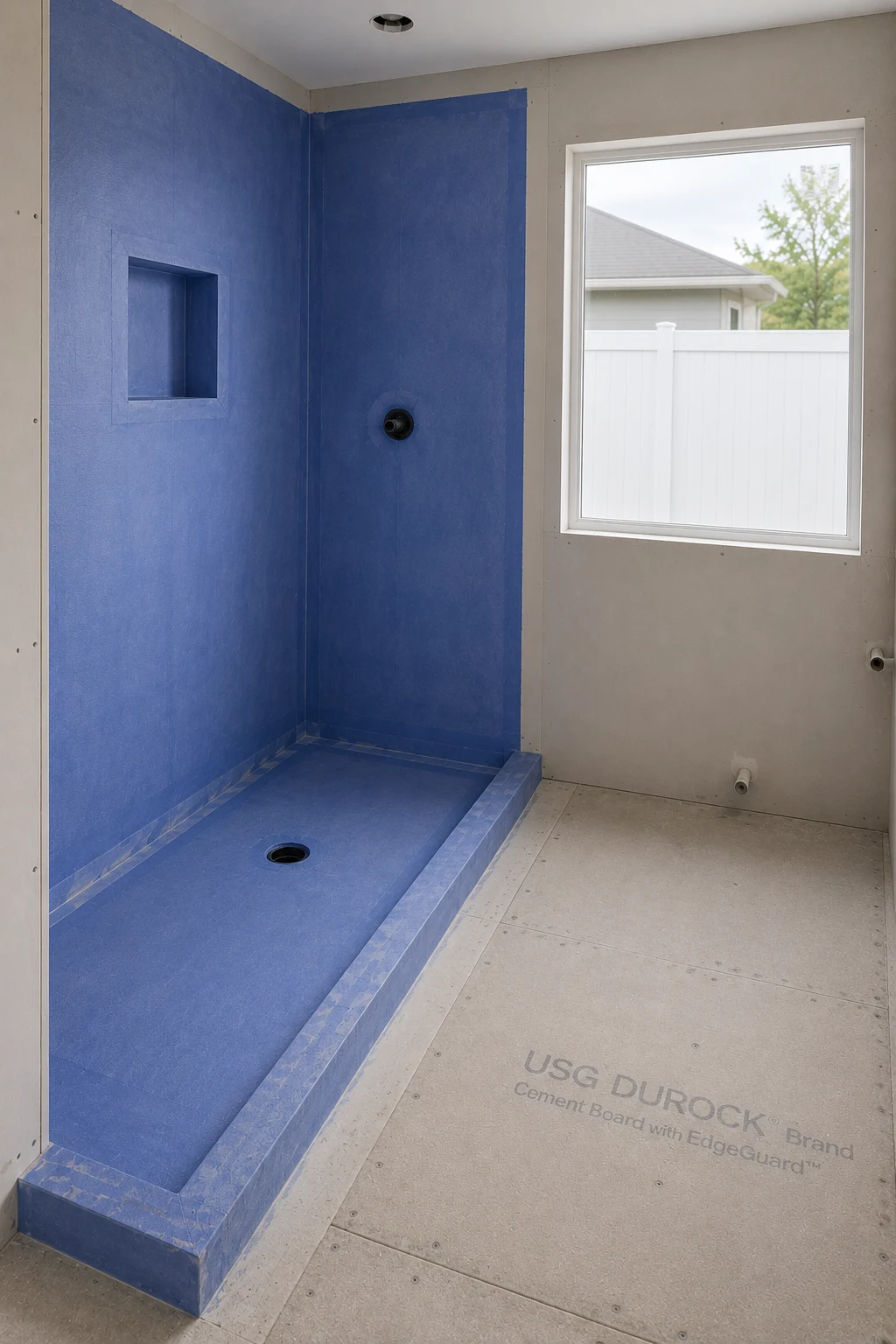
The waterproofing specification comes first, because it is the difference between a shower that lasts and one that becomes a structural repair. The membrane or board system, the treatment of corners and the pan detail should be named. Materials rated for constant wet exposure behave differently from materials that merely tolerate a spill, a distinction that runs through every waterproof and durable surface decision in the house and matters most inside the shower.
The second is where the work stops. Bathroom floors rarely end at the bathroom door, and a quote should say whether the new floor stops at the threshold or continues into the hall — because a transition strip and a continuous flooring run are different jobs with different prices and different results.
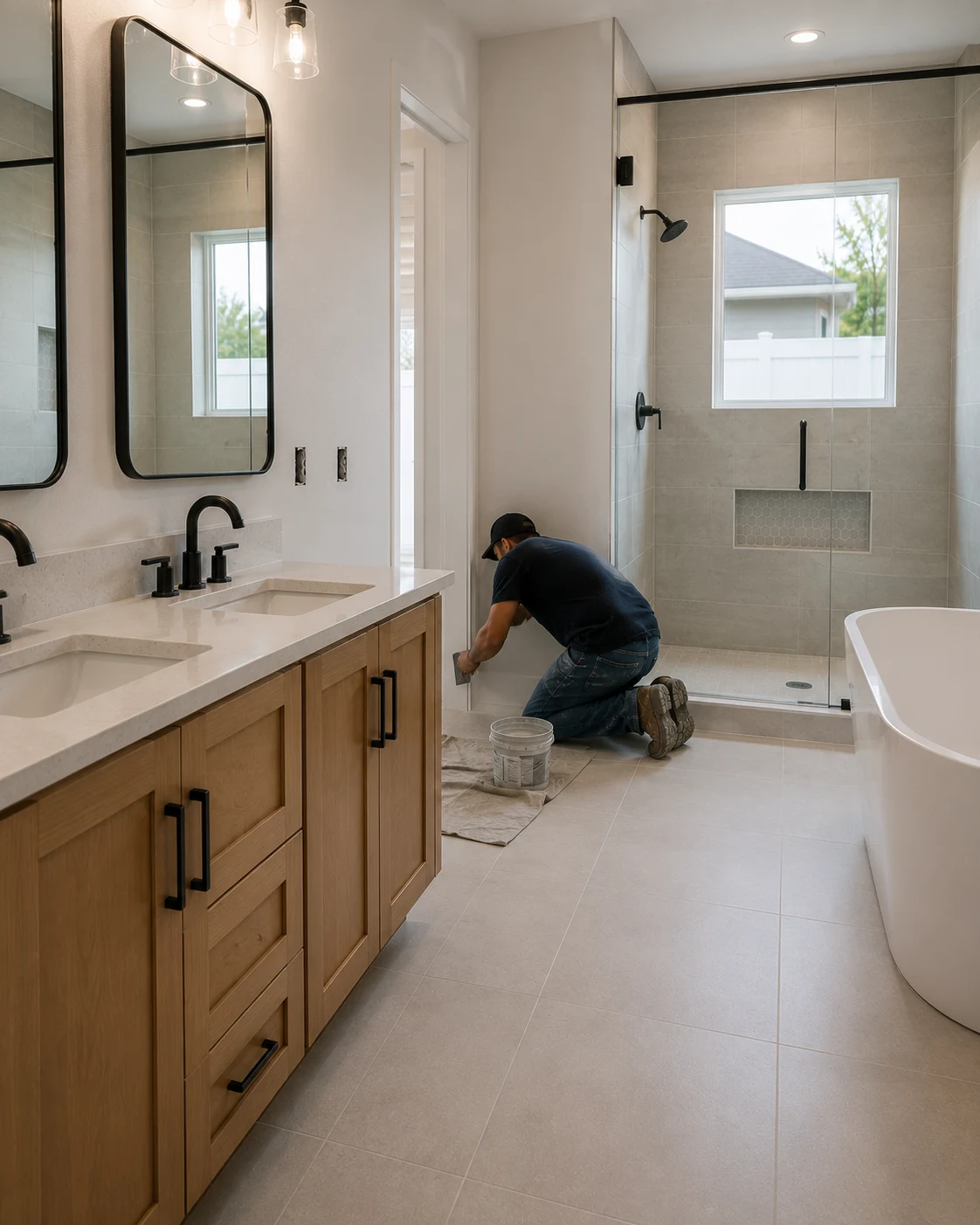
The third is the finishing trades. Drywall patching and paint are the last things to happen in a bathroom and the easiest to leave out of a scope, so confirm whether painting the room after tile and trim is included or whether you will be arranging it separately once the crew has left.
What a quote costs and how the figure is assembled is a separate subject with its own logic, set out in our guide to what a bathroom remodel costs. For hiring purposes the total matters less than whether the document describes a specific bathroom or a generic one.
Payment, change orders and the paperwork that protects you
Three documents decide how the project ends, and all three are agreed before it starts.
Payment should be tied to milestones that can be observed — rough-in complete and inspected, waterproofing installed, tile set, fixtures in — rather than to dates on a calendar. A schedule tied to dates pays for time; a schedule tied to milestones pays for progress.
Change orders should be written and priced before the work happens, without exception. Bathrooms produce more discovered conditions than any other room, so this clause is used more often here than anywhere else in a house.
Lien releases are the third and the one homeowners most often skip. Florida has a construction lien law that allows subcontractors and suppliers who were not paid to make a claim against the property even when the homeowner has paid the general contractor in full, which is why payment applications are normally accompanied by releases from the parties being paid. The mechanics are a legal matter rather than a construction one, and worth reviewing with your own adviser on a project of any size.
One practical detail belongs with the paperwork: confirm which building department will issue the permit. Around Orlando, a house inside the city limits and a house in unincorporated Orange County are handled by different offices, with different processes and different scheduling. A contractor who knows which one applies to your address has worked in your area recently.
Plumbers vs. General Contractors for Bathrooms
This is the question homeowners ask last and should ask first, because it decides everything downstream: who pulls the permit, who owns the schedule, and who is responsible when water appears where it should not.
What a plumbing contractor is licensed to do
A licensed plumbing contractor handles the water and the waste: supply lines, drain, waste and vent piping, fixture setting, valve bodies, water heaters, repiping and drain relocation. Within that scope, a plumber is the specialist and a general contractor is not.
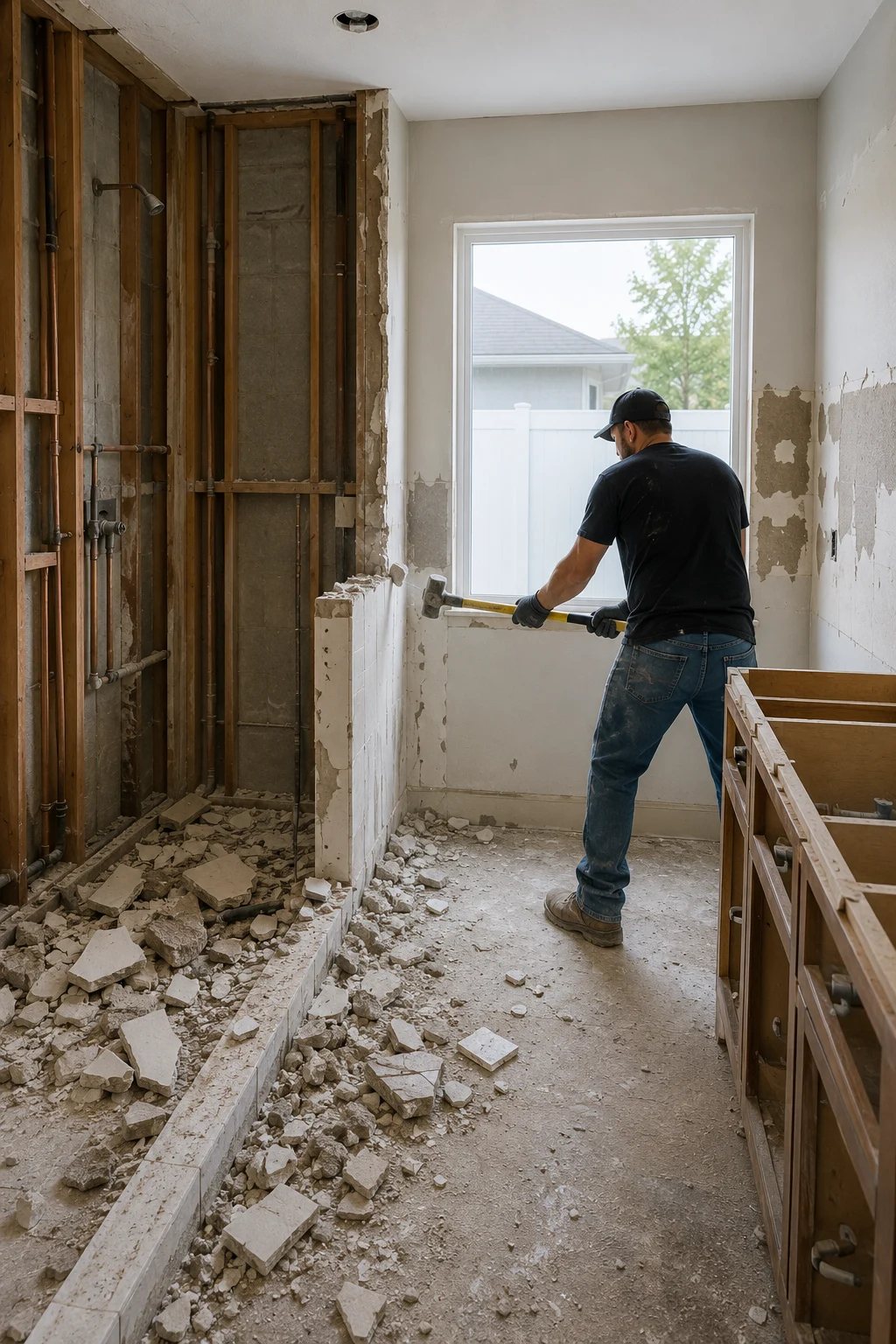
What falls outside it is equally clear. Framing, backer board, waterproofing membranes, tile setting, drywall, electrical circuits, exhaust ventilation, shower glass, cabinetry and paint are other trades. In Florida the boundary is a licensing boundary rather than a matter of preference, since plumbing is a separately licensed category from general construction.
That is why the choice is not really between two kinds of company. It is between two kinds of project.
The assembly nobody owns in a self-managed bathroom
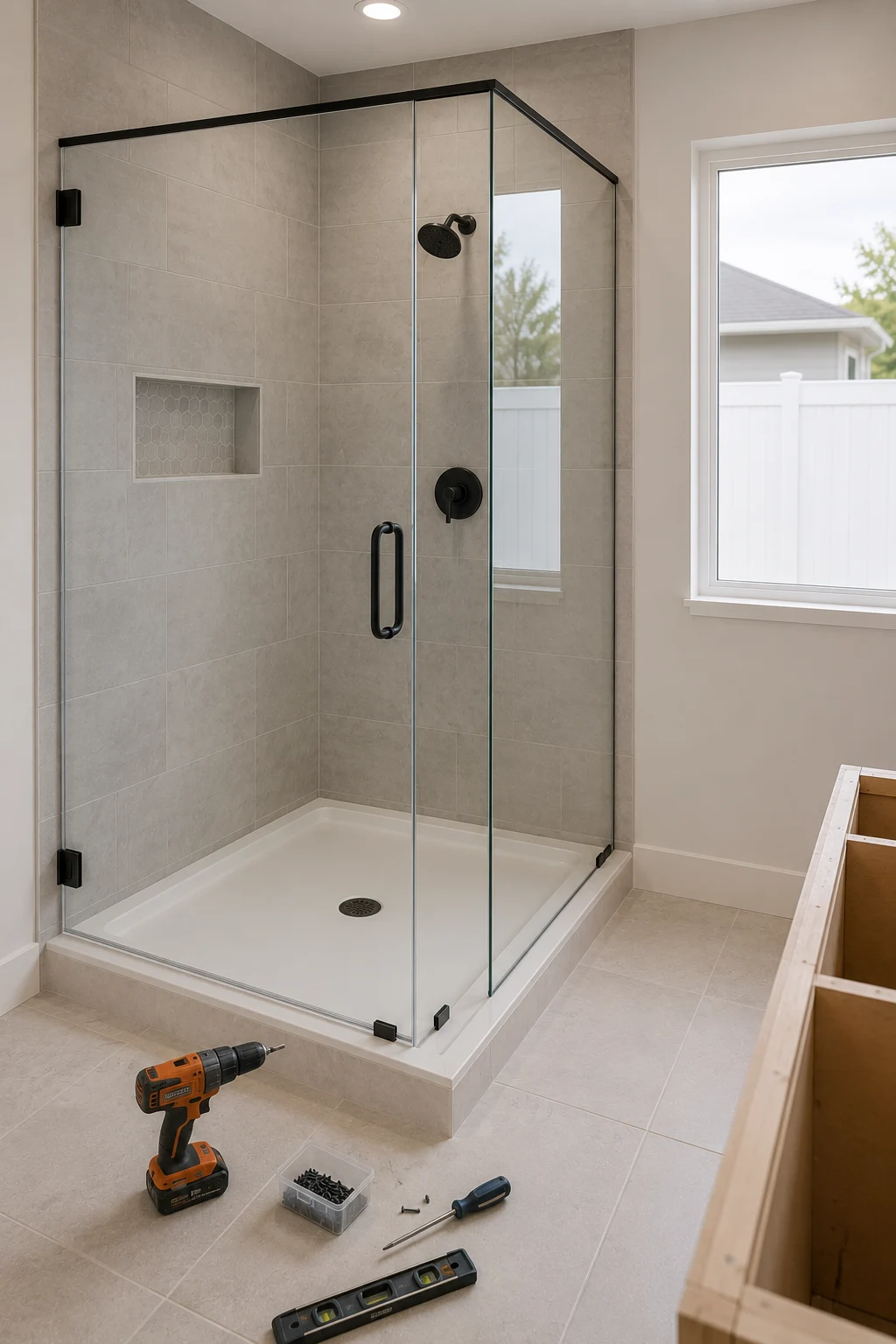
A shower is not a collection of components. It is one assembly, and it either works as one or it leaks.
The pan has to slope correctly to a drain that is compatible with the waterproofing method used above it. The membrane has to be continuous through the corners, up the curb and behind the niche. The substrate has to be the right board for the system. The tile and grout sit on top of all of it and hide every decision underneath.
When a homeowner hires a plumber and a tile setter under two separate agreements, that assembly is split across two contracts — and the boundary between them is exactly where failures happen. A leak six months later produces two competent tradespeople each correctly pointing at the other side of the interface.
Sequencing is the second cost of self-management. Plumbing rough-in has to be inspected before the walls are closed, which means the inspection sits between two trades and the person who booked it owns the calendar. If the tile setter arrives before the inspection passes, someone waits and someone bills for it.
Choosing between a plumber, a general contractor and a bathroom specialist
Three routes exist and each is correct for a different project.
| Plumbing contractor | General contractor | Bathroom remodeling company | |
|---|---|---|---|
| Suited to | Fixture, valve, drain or water heater work | Bathroom inside a larger or structural project | Full bathroom rebuild as a single job |
| Who coordinates the trades | You do | The contractor | The contractor |
| Waterproofing responsibility | Normally outside scope | Subcontracted, contractor responsible | In house, one warranty |
| Permit normally applied for by | Plumber, for plumbing-only scope | The contractor | The company |
| Selections and layout | Not included | Varies by company | Usually included |
| Where it typically goes wrong | Gaps between separate contracts | Small room low in a large schedule | Scope agreed too loosely at the start |
| Cost profile | Lowest for narrow scope | Coordination priced into the total | Coordination priced in, fewer change orders |
Read by scenario, the verdict is unusually clean. Call a plumber when the work is plumbing: a failing valve, a water heater, a leaking supply line, a toilet reset, a like-for-like fixture swap with no tile involved. Call a general contractor when the bathroom is one part of something larger, when walls move, or when structural work is in scope. Call a bathroom company when the room is being rebuilt and you want one contract covering demolition, rough-in, waterproofing, tile, fixtures and finishing.
The mixed case is the one worth naming: a tub-to-shower conversion looks like plumbing and is not. The drain moves, the wet area grows, and the entire waterproofed assembly is rebuilt. It belongs with whoever owns the assembly, not with whoever owns the pipe.
When hiring a remodeling company is the wrong call
There are projects where a remodeling contractor is the wrong answer, and saying so is more useful than pretending otherwise.
If a valve drips, a water heater has stopped, a drain runs slowly or a single fixture needs replacing in place, call a licensed plumber. It is faster and cheaper, and no coordination is required. If the bathroom functions and simply looks dated, paint, a mirror, a light fitting and new hardware will change the room considerably without anyone opening a wall.
The opposite case is worth watching for too. When the bathroom is one of several rooms being addressed, hiring separately for each one is usually the more expensive route, because whole home remodeling shares mobilisation, trades and material orders across the project rather than paying for them repeatedly.
Once you know which of those three routes your project belongs to, the shortlist stops being a list of companies and becomes a list of the right kind of company — which is the only version of the list worth calling.
Share this article